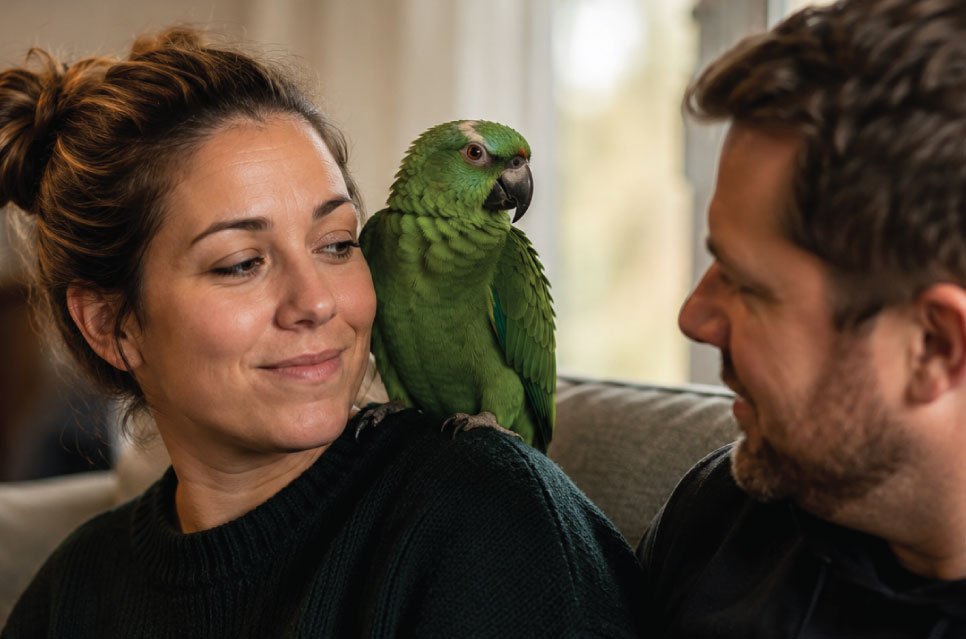
Quick Guide: Do Birds Get Jealous?
- It is survival, not spite: What looks like human jealousy is actually mate guarding and resource protection deeply hardwired into avian instincts.
- Watch the warning signs: Pinning eyes, fanned tail feathers, and low crouches are immediate physical signals before a “jealous” bite or lunge occurs.
- Stop accidental rewards: Screaming or pulling away dramatically when your bird attacks a partner only reinforces the aggression by providing high-energy attention.
- Share the caretaking: Having the “disfavored” family member deliver all high-value treats and favorite meals is the fastest way to rewire your bird’s loyalty.
You finally sit down on the couch to hug your partner, and suddenly your normally sweet feathered companion turns into a dive-bombing, screeching little green monster. If you have ever felt like your bird is actively trying to ruin your romantic relationship or drive your family members out of the room, you are not imagining things. Seeing a pet bird lunge, bite, or scream whenever someone else approaches their favorite human is both frustrating and heartbreaking for pet parents who just want a peaceful home.
Many online guides dismiss this behavior as quirky bird attitude, but dealing with avian rivalry requires a strategic approach rooted in animal psychology. This guide breaks down exactly what triggers territorial possessiveness in pet birds and gives you step-by-step, actionable training routines to restore peace to your household. You will learn how to read the subtle behavioral triggers before an attack happens and how to transform your bird from a one-person bodyguard into a well-adjusted family flock member.
The “One-Person Bird” Syndrome and Flock Hierarchy
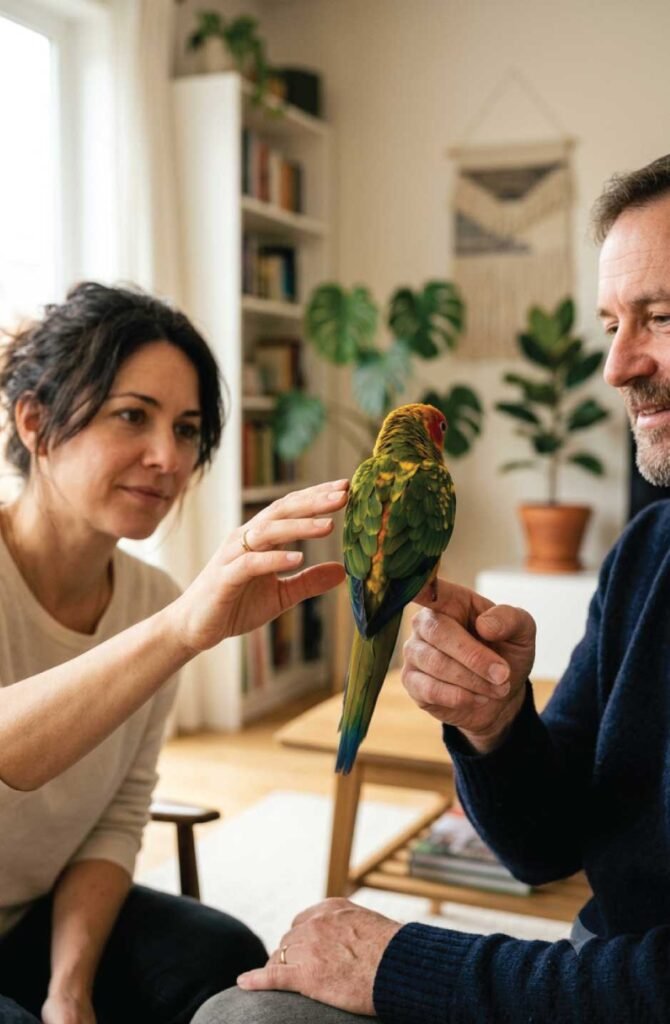
In the wild, parrots and many companion birds survive by choosing a single, lifelong mate who provides protection and shares daily foraging duties. When a bird lives in a human home, they naturally select one person to act as their exclusive bonded mate and view everyone else in the house as an intruder. This is not malice; it is a primal instinct to guard their most valuable resource, you. If your spouse or child steps too close, your bird perceives an immediate existential threat to their food security and social safety. Understanding this critical shift from human jealousy to avian resource guarding is the very first step in reshaping how your household interacts with your pet. To dive deeper into how your bird communicates these intense social preferences, check out our guide on Pet Bird Body Language Explained.
- Transfer feeding duties: Have the “disfavored” family member become the sole provider of breakfast and high-value treats for at least two weeks to build positive associations.
- Practice step-away handoffs: Hand your bird over to the other person while you step completely out of the room, removing yourself as a high-value resource to guard.
- Avoid exclusive shoulder rides: Stop letting your bird perch on your shoulder when other people are present, as physical height artificially elevates their dominance in the flock hierarchy.
Reading the Micro-Signals Before an Aggressive Lunge
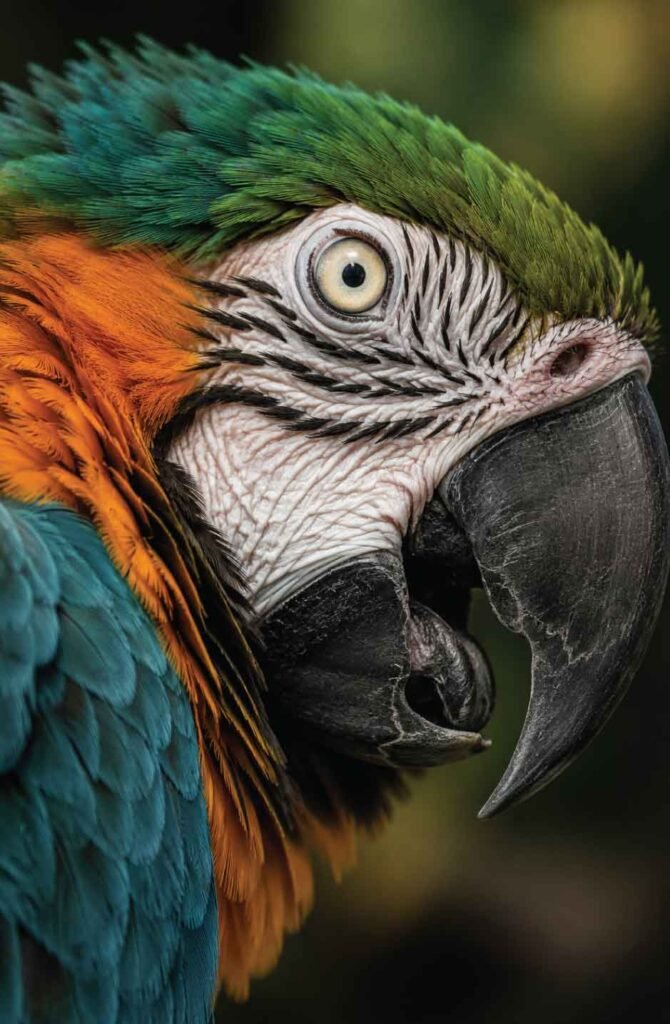
Birds are prey animals that rarely attack without giving several polite, silent warnings first. Before a jealous bird bites or lunges at a family member, their body language undergoes a rapid, highly predictable physical transformation. You might notice their eye pupils rapidly shrinking and expanding, a phenomenon known as eye pinning, or observe them puffing out the feathers around their neck while spreading their tail feathers like a fan. Ignoring these crucial physiological signs pushes the bird over their emotional threshold, leaving them with biting as their only remaining option to defend their territory. According to behavioral researchers at the Cornell Lab of Ornithology, birds rely heavily on these visual displays in the wild to establish boundaries without risking injury in physical confrontations.
- Watch for eye pinning: If your bird’s pupils flash rapidly when a family member enters the room, immediately create distance between the bird and that person.
- Look at the tail: A fanned tail combined with a lowered head means a lunge is imminent; never attempt a step-up command when this defensive posture occurs.
- Redirect immediately: Use a neutral hand-held perch or a target stick to move the bird to a safe playstand before their frustration escalates into screaming or biting. If vocal outbursts accompany these posturings, our resource on Why Is My Bird Suddenly Screaming? can help you troubleshoot the noise.
Hormonal Overdrive and Seasonal Mate Guarding
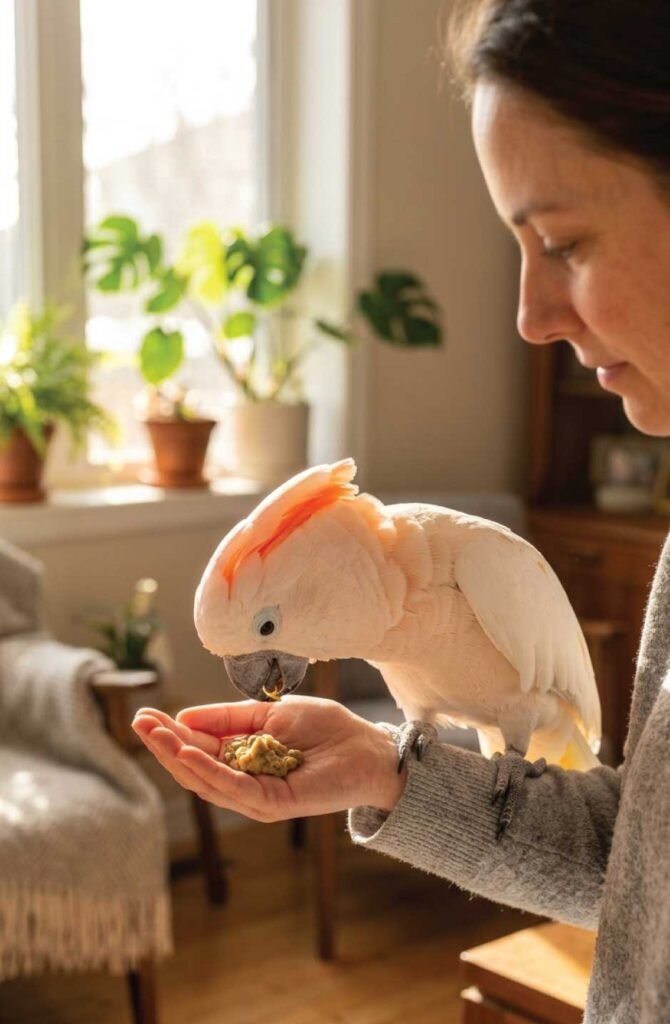
Springtime brings longer daylight hours, which acts as a powerful biological trigger that floods your bird’s system with breeding hormones. During hormonal peaks, a companion bird’s protective instincts skyrocket, turning mild territorial preferences into aggressive mate guarding. During these months, your bird may start regurgitating food for you, rubbing against your hand, or obsessively searching for dark, enclosed spaces like cardboard boxes or couch cushions to build a nest. When a pet owner accidentally encourages these courtship behaviors, the bird becomes convinced that they are officially a breeding pair, making their attacks on other human household members tenfold more vicious.
- Enforce sleep schedules: Ensure your bird gets 10 to 12 hours of uninterrupted, pitch-black sleep every night to trick their biological clock out of breeding mode.
- Pet only the head: Never stroke your bird’s back, wings, or tail, as touching anywhere below the neck stimulates mating behaviors and intense possessiveness.
- Eliminate nesting sites: Remove fabric tents, happy huts, cardboard boxes, and dark corner spaces from the cage and play areas immediately.
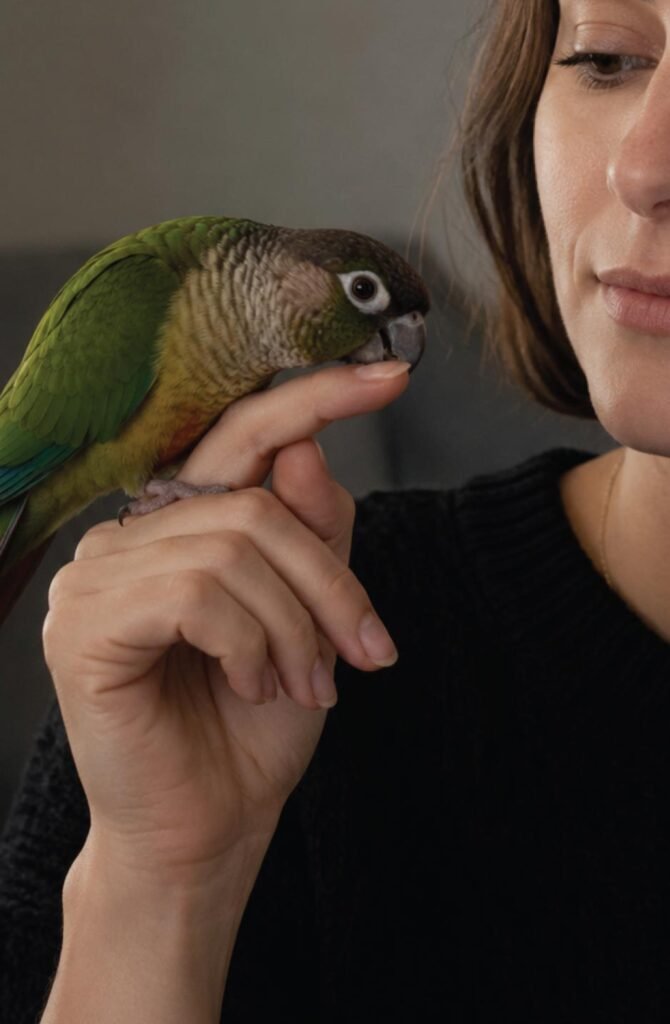
Breaking the Accidental Reinforcement Loop
Human reactions to bird bites are often loud, dramatic, and emotionally charged, which happens to be exactly what intelligent parrots find thrilling. When a partner yells, waves their arms, or laughs after being lunged at by a jealous bird, they inadvertently reward the aggression with high-energy attention. To a bored parrot, getting a massive theatrical reaction from a human is a fun interactive game, even if that human is visibly angry. This creates a toxic reinforcement loop where the bird actively seeks out the “rival” family member just to trigger a chaotic, stimulating show.
- Adopt the stone-face response: Instruct all family members to remain completely silent and expressionless if the bird nips or lunges at them.
- Use the earthquake technique: If the bird bites while on a hand or arm, gently drop your arm an inch to unbalance them slightly, shifting their focus to gripping rather than biting.
- Reward calm coexistence: Toss a favorite treat into the bird’s bowl the exact second they sit quietly while the bonded human hugs or talks to another family member.
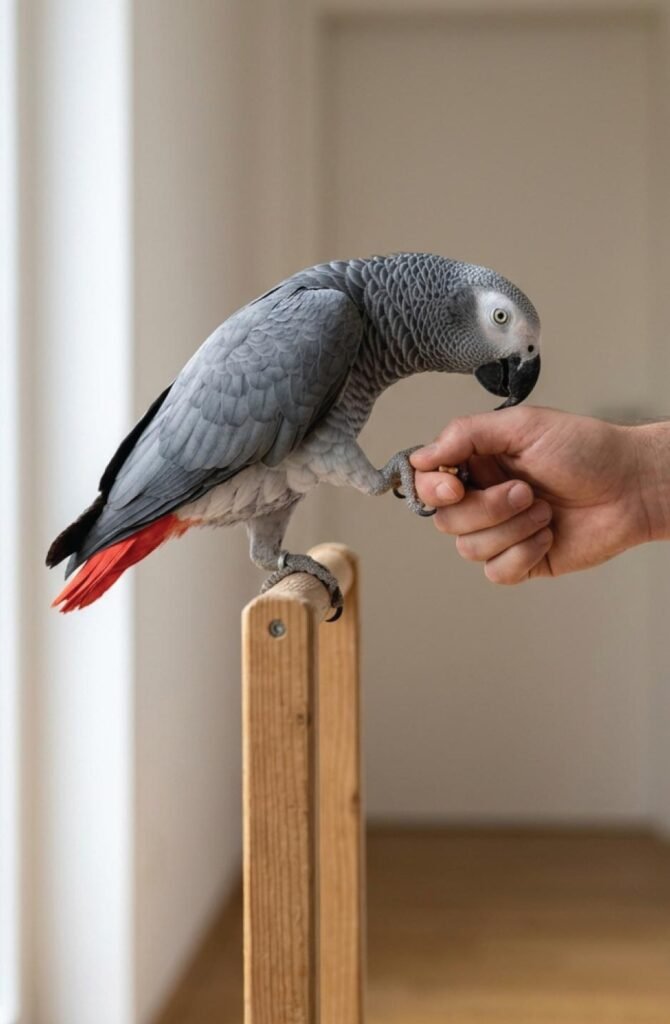
Establishing Neutral Zones for Flock Socialization
Territorial behavior is exponentially worse around a bird’s cage and their favorite human’s personal space, such as the home office desk or bedroom. Training a jealous bird to accept other family members must always take place in a neutral room where the bird has no established territorial claims. When a parrot is away from their safe cage territory and their bonded human’s lap, their natural defensiveness drops significantly, making them much more receptive to stepping onto a new person’s hand. Avian veterinarians emphasized in the Merck Veterinary Manual that modifying environmental context is the most reliable way to reset entrenched behavioral loops in companion exotics.
- Pick a fresh room: Use a guest room, dining room, or hallway where the bird does not usually spend free time or have an established playgym.
- Conduct solo training sessions: Have the disfavored person work on basic “step-up” commands in this neutral room while the bonded human is completely absent from the house or floor.
- Keep sessions short: Limit training to 5-minute intervals to ensure you end on a positive, successful note before the bird becomes fatigued or anxious.
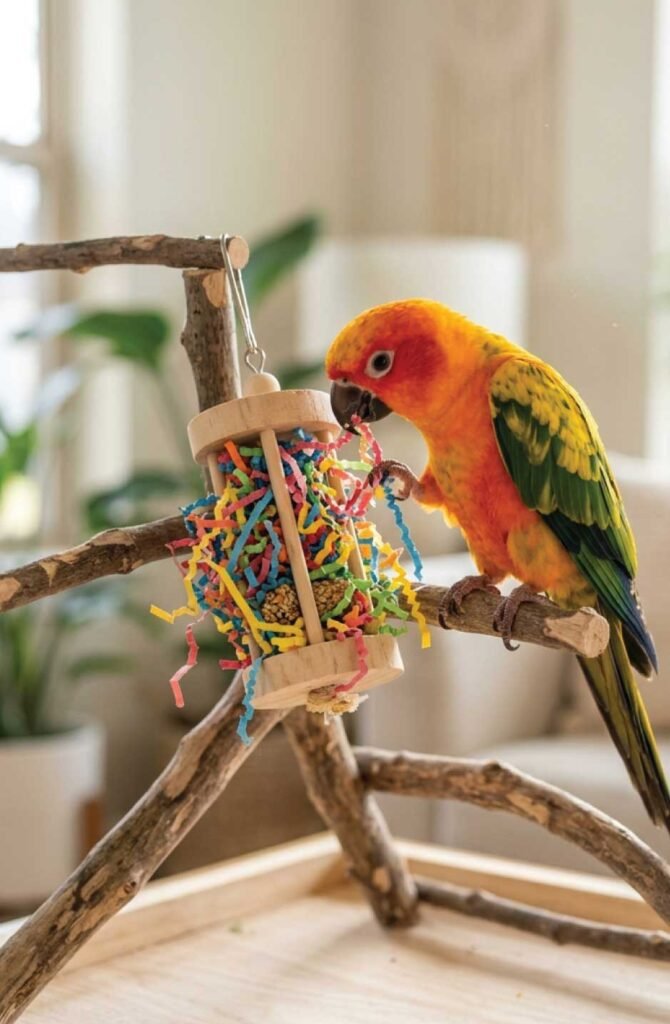
Channeling Social Obsession into Independent Enrichment
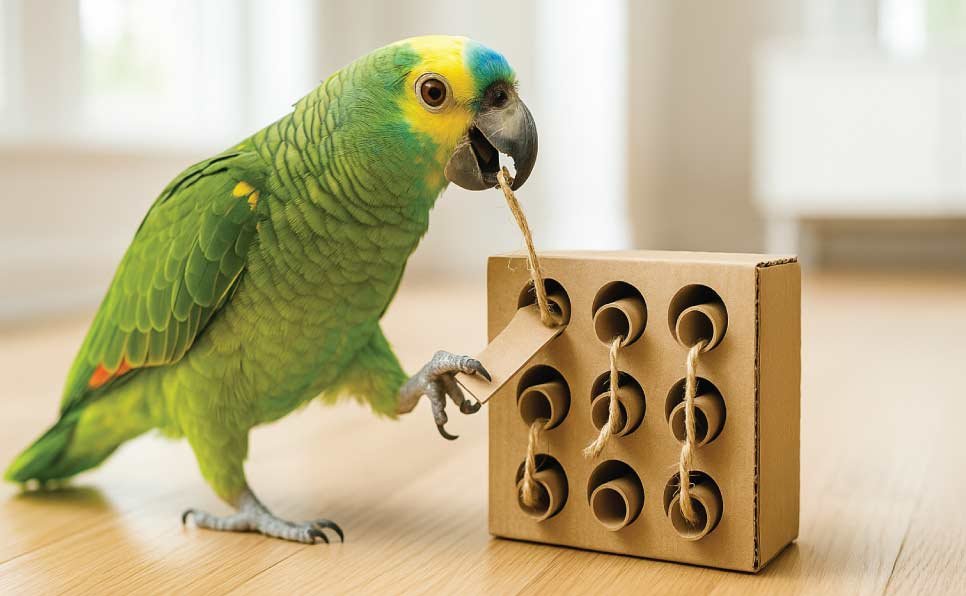
A bird that clings to you like Velcro and attacks anyone who interrupts is often suffering from severe under-stimulation and boredom. When companion birds lack adequate foraging challenges and independent play options, they make their human caregiver their sole source of mental stimulation. Building your bird’s self-confidence through independent activities naturally lowers their anxiety around other people and reduces their desperate need to guard your attention. Investing time into building engaging foraging puzzles can completely transform a clingy bird’s daily routine; explore our favorite easy ideas in 20 DIY Parrot Toys: Keep Your Parrot Entertained and Happy.
- Hide daily rations: Stop serving seeds and pellets in an open bowl; instead, wrap food in unbleached coffee filters or paper towels so the bird must work to eat.
- Create a solo play station: Set up an engaging tabletop playgym across the room from your desk and reward the bird every time they choose to play there alone.
- Introduce destruction toys: Provide soft balsa wood, mahogany pods, and woven finger traps to give them a healthy, physical outlet for pent-up energy and frustration.
The Secret Sauce
The “Bridge Treat” Technique for Fearful Family Members
Most people pull their hand away timidly when offering a treat to a jealous bird, which only invites a swift bite to the fingers. To safely bridge the trust gap, have the disfavored family member feed the bird using a wooden spoon or a long spray millet branch as an extension of their hand. This simple physical buffer removes the person’s fear of getting bitten, keeps their hand steady, and teaches the bird that good things happen when this “rival” human approaches, all without risking skin contact.
The 12-Hour Darkness Reset for Hormonal Overdrive
When standard adjustments fail to calm a fiercely protective bird, their circadian rhythm usually needs a hard reset. Placing your bird in a dedicated sleep cage located in a quiet, climate-controlled closet or spare room for exactly 13 hours a night can break hormonal mate-guarding cycles in less than a week. Covering a cage in a noisy living room does not work; total silence and complete darkness are required to lower the endocrine levels driving their territorial possessiveness.
The Reverse-Attention Trick That Stops Lunging Instantly
Traditional discipline fails with birds because any attention is seen as a validation of their behavior. The moment your bird lunges at a family member, turn your back to the bird completely and walk away for sixty seconds without saying a single word. Because your attention is the ultimate reward they are fighting to protect, instantly removing your presence whenever they act aggressively teaches them that possessive lunging causes them to lose their favorite human entirely.
Frequently Asked Questions About Do Birds Get Jealous?
Yes, species with complex social hierarchies and intense monogamous pair bonds are significantly more possessive of their chosen humans. Larger parrots like Amazon parrots, Cockatoos, and Macaws are notorious for fierce mate-guarding, while solitary or flock-oriented small birds like Canaries and Finches rarely exhibit territorial possessiveness. Budgies, Lovebirds, and Cockatiels fall in the middle, often showing clear human preferences and vocal scolding without the dangerous physical aggression of larger companion birds.
Birds view handheld objects and screens as direct competitors for your daily visual focus and physical affection. When you stare at a phone or laptop, your bird perceives that inanimate object as an intruding rival stealing their bonded mate's attention, prompting them to bite, scream, or push the item away. To prevent screen rivalry, set up a dedicated tabletop foraging toy right next to your desk to keep your bird's beak and brain occupied while you work.
Young, hand-fed chicks are usually universally friendly, but their social dynamics change drastically once they hit avian puberty. Territorial possessiveness and mate-guarding typically emerge when a bird reaches sexual maturity, which ranges from 6 to 12 months for small species and 3 to 5 years for large parrots. This sudden hormonal shift is the exact reason why many "sweet" adolescent birds suddenly develop Jekyll-and-Hyde personalities as adults.
Absolutely, companion birds view all household animals through the lens of flock hierarchy and resource competition. A pet bird will frequently scream, fluff up, or even dive-bomb a dog or cat that approaches your lap because they view the four-legged pet as an intruder infringing on their safe nesting territory. However, never allow a bird to "correct" or chase another pet, as a startled predatory reflex from a cat or dog can turn fatal for the bird in a split second.
Unlike mammalian pets, surgical sterilization is almost never performed on companion birds to resolve behavioral or territorial issues. Spaying or neutering a bird requires risky, invasive internal cavity surgery that carries a high probability of fatal hemorrhaging, making environmental modification the only safe way to manage avian hormones. If hormonal mate-guarding becomes severe and unmanageable through sleep and lighting changes, an avian veterinarian may recommend temporary hormone-reducing injections or subdermal implants instead of surgery.
Avian alliances are not set in stone and can shift dynamically several times over a companion bird's long lifespan. A pet bird will frequently switch their primary allegiance to a new favorite person if their original chosen human moves away, changes their work schedule, or breaks trust through forced handling. Providing consistent, hands-off socialization and treat-sharing from everyone in the household ensures your bird remains comfortable with the entire family rather than fixating on a single caregiver.
Restoring Peace to Your Feathered Family
Dealing with a bird that acts jealous can feel isolating, but remember that your feathered friend is simply following millions of years of survival instincts. What feels like spiteful jealousy is actually an expression of pair bonding, territorial security, and hormonal drives that can be reshaped with consistent, patient training. By recognizing their subtle body language warnings, removing accidental rewards for aggression, and allowing other family members to become high-value treat providers, you can dismantle their defensive behaviors step by step.
With a little time and the right boundaries, your little “one-person bodyguard” will learn to relax and enjoy the safety of a multi-person flock. Remember that consistency across your entire household is the secret to lasting behavioral success!
Pin this for later by saving this guide to your favorite Pinterest pet board so you always have these training techniques handy when behavioral bumps arise!
Ready for your next step in building an amazing bond with your feathered companion? Check out our comprehensive guide on How Long Does It Take to Train a Bird? A Guide for Beginners to master the foundational timeline for trust and obedience!