Quick Guide: Bird-Safe Houseplants
- Prioritize the “Resilient Three”: For birds that love to shred, stick to the Spider Plant (indestructible and non-toxic), the Boston Fern (adds healthy humidity), and the Areca Palm (serves as a natural climbing gym).
- Beware of Lookalikes: Never trust “Lucky Bamboo” (sold in water jars); it is a toxic Dracaena. Only True Bamboo (Bambusa species) is safe for birds to chew and perch on.
- The “Soil Trap” & Pesticides: Most store-bought plants contain chemical fertilizers or perlite (volcanic glass) in the soil. Always repot new plants into organic, chemical-free soil and rinse the leaves thoroughly to remove nursery pesticide residue.
- Manage the “Delicates”: Beautiful options like African Violets and Orchids are non-toxic, but very fragile. Keep these as “visual-only” decor in spots where your bird can’t reach, or be prepared for them to be shredded in minutes.
- Absolute No-Go’s: Never allow Avocado (highly lethal), Dieffenbachia (causes throat swelling), or Philodendrons in a bird-accessible room.
Introduction: Why Your Choice of Greenery Matters
Let’s talk about something that might not be on your radar but absolutely should be: Bird-Safe Houseplants. If you’re a bird owner who also loves a good jungle of houseplants (guilty!), you need to know that not all greenery is created equal when you’ve got curious beaks exploring every corner of your home.
Here’s the thing about birds, they’re natural explorers. Your parrot, budgie, or cockatiel doesn’t see a plant and think, “Hmm, I wonder if this is toxic?” Nope. They see it and think, “Let me nibble this immediately!” It’s just how they’re wired. In the wild, birds investigate their environment with their beaks, testing textures, tasting new things, and generally getting into everything. This adorable curiosity becomes a serious safety concern when you bring plants into your home that could poison them.
And here’s what makes this even more critical: birds are exceptionally sensitive to toxins. Remember learning in history class about canaries in coal mines? That wasn’t just a random choice. Birds have incredibly efficient respiratory systems that make them fantastic early warning systems for air quality issues, but this same biological feature means they’re far more vulnerable to environmental toxins than we are. What might give you a mild stomachache could seriously harm or even kill your bird.
But don’t worry, I’m not about to tell you to give up your beloved houseplants! The good news is that you absolutely can balance beauty and safety. Indoor plants offer amazing benefits like improved air quality, reduced stress, and that whole bringing-nature-indoors vibe that makes your space feel alive. You just need to be smart about which ones you choose. By sticking with plants documented as non-toxic to birds, you can create a lush, green sanctuary that’s safe for everyone with feathers in your household.
If you’re newer to living with birds, plant safety is just one piece of the bigger picture. Understanding how birds interact with their environment, what stresses them, and what supports their well-being makes it much easier to create a truly safe home. If you want a broader foundation, you might also enjoy reading Best Pet Birds for Beginners, which explore daily care, social needs, and beginner-friendly expectations in more depth.
The Safe List: Ranked from Most Functional to Most Delicate
Now, let’s get to what you really came here for, the actual list of safe plants! I’ve organized these not just by safety (they’re all safe), but by how well they’ll hold up to the inevitable beak damage, how functional they are for your bird, and their overall durability. Think of this as a guide that respects both your bird’s natural behaviors and your desire to keep living plants, not shredded plant corpses. Reputable references like the ASPCA’s database of non-toxic plants help confirm which houseplants are considered safe around birds and other pets.
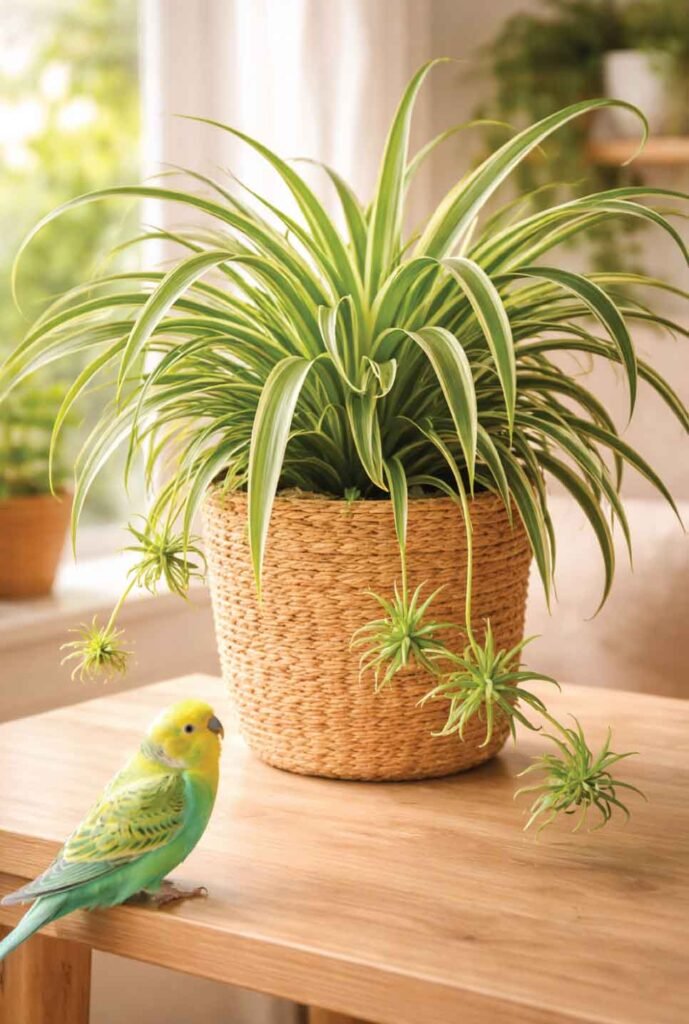
Spider Plant (Chlorophytum comosum) The Ultimate Choice
If you only get one bird-safe plant, make it a spider plant. Seriously, this is the gold standard for bird households, and there are some really solid reasons why.
- First, it’s completely non-toxic. Your bird can munch away without you losing sleep over potential poisoning. But what really puts the spider plant in the number one spot is its incredible resilience. These plants are basically indestructible. Your bird can nibble the leaves, tug at the hanging plantlets (those adorable little “pups” that dangle down), and even chomp it down to nearly nothing, and the spider plant will just… grow back. It’s like the superhero of houseplants.
- Here’s a bonus feature: many birds absolutely love foraging on those hanging plantlets. It gives them something to do, satisfies their natural instinct to explore and chew, and provides enrichment without any risk. Plus, spider plants are excellent air purifiers, removing toxins like formaldehyde and xylene from your indoor air. Your bird gets a safe snack, you get cleaner air, and the plant survives the experience. That’s what I call a win-win-win situation.
- Care-wise, spider plants are ridiculously easy. They tolerate a range of lighting conditions, don’t need constant watering, and propagate like crazy (you’ll have baby plants to share with all your bird-loving friends). Even if you don’t have the greenest thumb, this plant will forgive you.
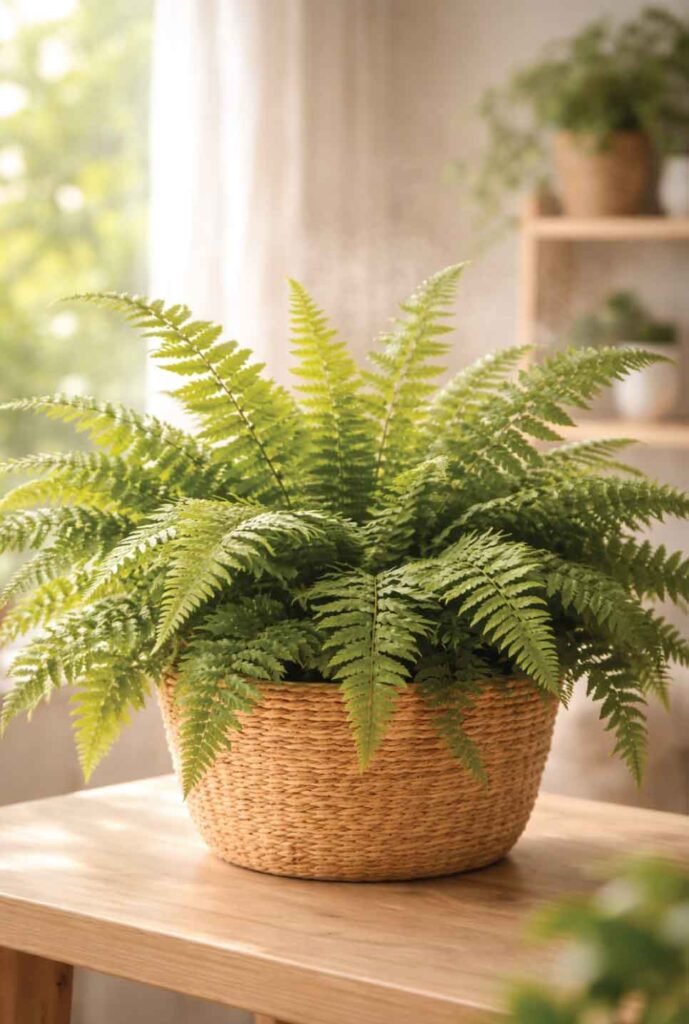
Boston Fern (Nephrolepis exaltata) The Natural Humidifier
Coming in at number two, we have the lovely Boston fern. These lush, feathery beauties aren’t just safe, they’re actually beneficial for your bird’s health in a really cool way.
- Boston ferns act as natural humidifiers. As they transpire (basically the plant version of sweating), they release moisture into the air. This is fantastic news for your bird’s respiratory system, which can suffer in dry indoor environments. Proper humidity levels help keep your bird’s respiratory tract healthy and comfortable, reducing the risk of respiratory infections and keeping those delicate air sacs in top shape. Air quality and humidity are often overlooked, but they play a huge role in bird health. Birds have incredibly sensitive respiratory systems, which is why things like dry air, fumes, and poor ventilation can cause problems over time. If you want to better understand common respiratory risks and warning signs, Bird Health: Common Pet Bird Diseases and Are Air Fresheners Safe for Birds? Risks and Safe Alternatives are helpful follow-up reads.
- The soft, feathery fronds are completely safe for birds to interact with. Some birds love hiding in the foliage, while others enjoy gently pulling at the fronds. The texture is interesting without being sharp or dangerous, and while your bird can definitely damage a Boston fern if they’re determined, these plants are more forgiving than many delicate houseplants.
- Now, I’ll be honest with you, Boston ferns can be a bit finicky to care for. They like consistent moisture and humidity, so they’re not quite as foolproof as spider plants. But if you can manage to keep them happy (regular watering, occasional misting, indirect light), they’ll reward you with gorgeous cascading foliage that makes any space feel like a tropical paradise. Just keep them where your bird can safely interact with them, and everyone benefits.
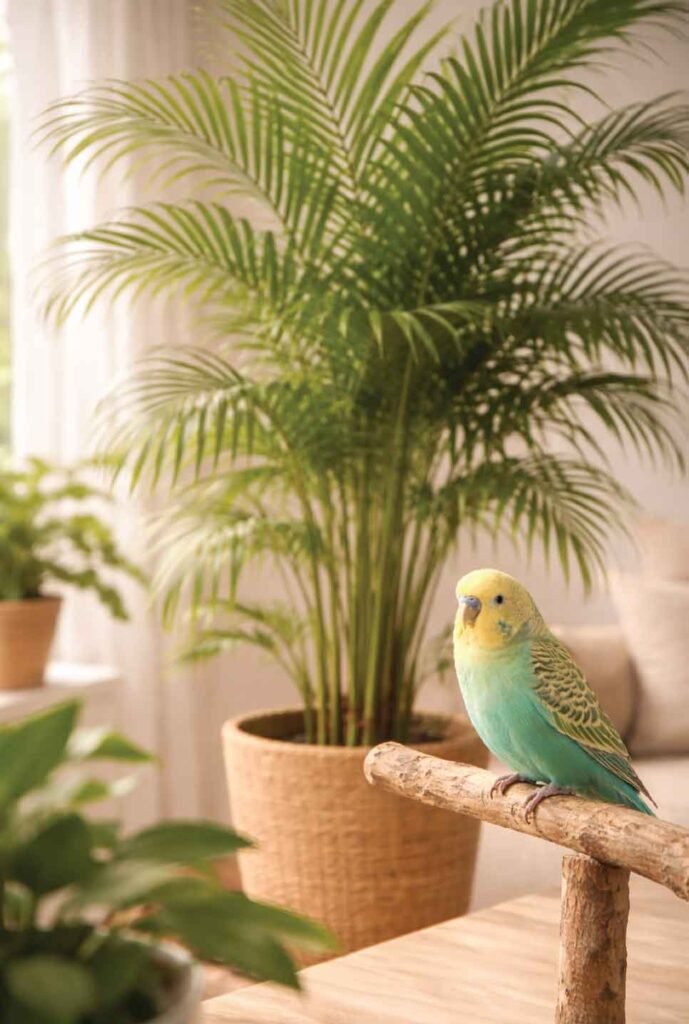
Areca Palm (Dypsis lutescens) The Indoor Play Gym
Let’s talk about the areca palm, which is basically a piece of functional bird furniture disguised as a houseplant. This one’s particularly great if you have smaller birds like budgies, cockatiels, or lovebirds.
- The areca palm is large enough and sturdy enough to serve as a natural play gym. Birds can perch on the fronds, explore the different levels, and generally treat it like their own personal jungle gym. It adds vertical interest to their environment and gives them options for climbing and exploring that more closely mimic what they’d experience in the wild.
- But here’s another reason to love it: this palm is an excellent air filter. Studies have shown that areca palms are particularly good at removing common indoor air pollutants like formaldehyde, which can off-gas from furniture, carpets, and building materials. Considering how sensitive birds are to air quality, having a natural air filter in your home is a pretty smart move. Creating a bird-safe space isn’t only about what’s toxic, it’s also about enrichment. Plants that allow safe climbing, perching, or visual stimulation can reduce boredom and stress, especially for intelligent species. If you’re interested in encouraging more natural behaviors, How Long Does It Take to Train a Bird? and How to Teach Your Pet Bird to Talk (From Mimicry to Meaning) explore how environment, stimulation, and trust all work together.
- The areca palm does best in bright, indirect light and likes to stay moist but not waterlogged. It’s reasonably hardy, though larger parrots can do some damage if they really go to town on it. For small to medium-sized birds, though, it strikes a nice balance between being interactive and durable. Plus, it looks absolutely gorgeous and adds that tropical, resort-like vibe to your space.
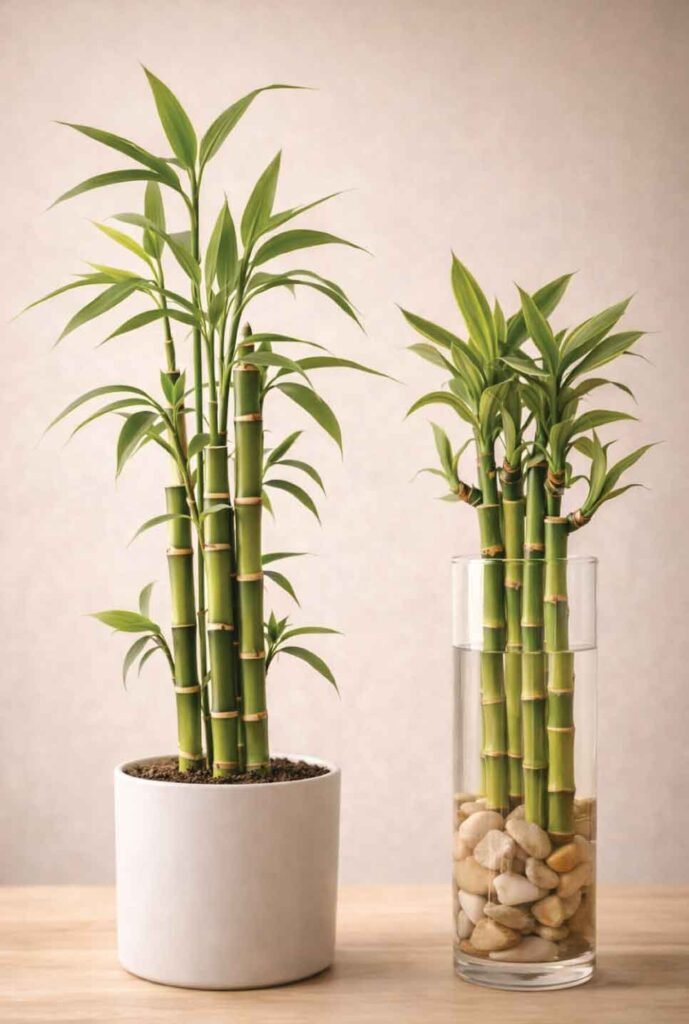
True Bamboo (Bambusa spp.) The Durable Fixture
Here’s where we need to have a very important conversation about bamboo, specifically, the difference between true bamboo and that thing sold as “Lucky Bamboo” in water jars at every home store ever. True bamboo is safe. Lucky Bamboo is absolutely not. We’ll talk more about that dangerous lookalike later, but for now, just know that when I say “true bamboo,” I mean actual woody bamboo from the Bambusa species.
- True bamboo is fantastic for bird households because it’s tough as nails. It’s technically a grass, and as anyone who’s tried to get rid of bamboo in their yard knows, this stuff is incredibly hardy and fast-growing. Your bird can chew on it, perch on it, and generally do their worst, and the bamboo will likely outlast them. This makes it an excellent permanent fixture in your bird’s environment.
- The woody texture is interesting for birds to explore, and the leaves are safe if they decide to nibble. Some bird owners even harvest bamboo leaves as safe, bird-approved foliage for their pets to shred. Plus, true bamboo can get quite tall, providing visual interest and privacy without taking up much floor space.
- The critical thing here is verification. When you’re shopping, make absolutely sure you’re getting true bamboo and not Dracaena sanderiana (Lucky Bamboo). Check the label, ask the nursery staff, and if you’re not 100% certain, don’t risk it. Real bamboo has woody, jointed stems and narrow, grasslike leaves. Lucky Bamboo has fleshier stems and broader leaves, and it’s often sold growing in water alone. When in doubt, skip it and choose something you know for certain is safe.
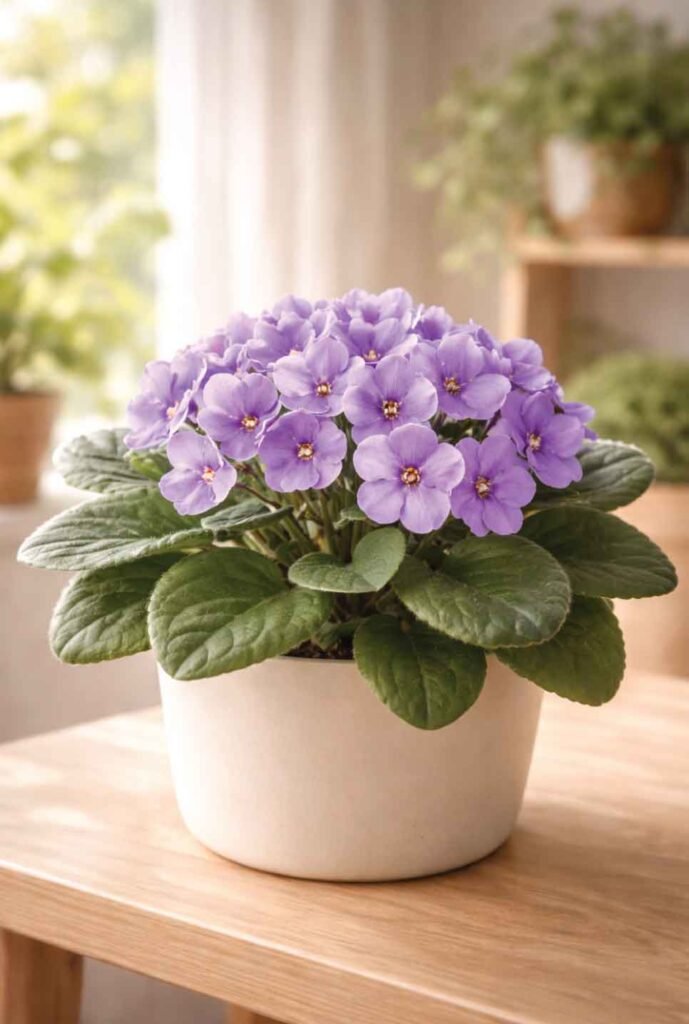
African Violet (Saintpaulia) The Splash of Color
Now we’re getting into the pretty, decorative plants that add serious aesthetic value to your space. African violets are completely non-toxic, leaves, blooms, and all, which makes them a wonderful choice for adding color to a bird-safe room.
These plants come in gorgeous shades of purple, pink, white, and even bi-colors, and they bloom reliably if you treat them right. They’re relatively small and compact, which makes them easy to position around your bird’s space without taking over your entire home. The fuzzy leaves and delicate flowers are interesting textures for birds who like to explore, though I’ll be honest with you, these are best suited for “soft” chewers.
What I mean by that is this:
- If you have a gentle budgie who likes to give things a little nibble and move on, an African violet can survive
- If you have a large parrot who treats every plant like a personal destruction project, you’re going to have sad, mangled violet remnants pretty quickly
But that’s okay! Even if your bird does take a bite, there’s no safety concern. The plant might look worse for wear, but your bird will be perfectly fine.
African violets do need some specific care, they like consistent moisture (but hate getting water on their leaves), and they prefer bright, indirect light. They’re not hard to keep, but they’re not quite as forgiving as, say, a spider plant. Think of them as an intermediate-level houseplant that rewards attention with reliable beauty.
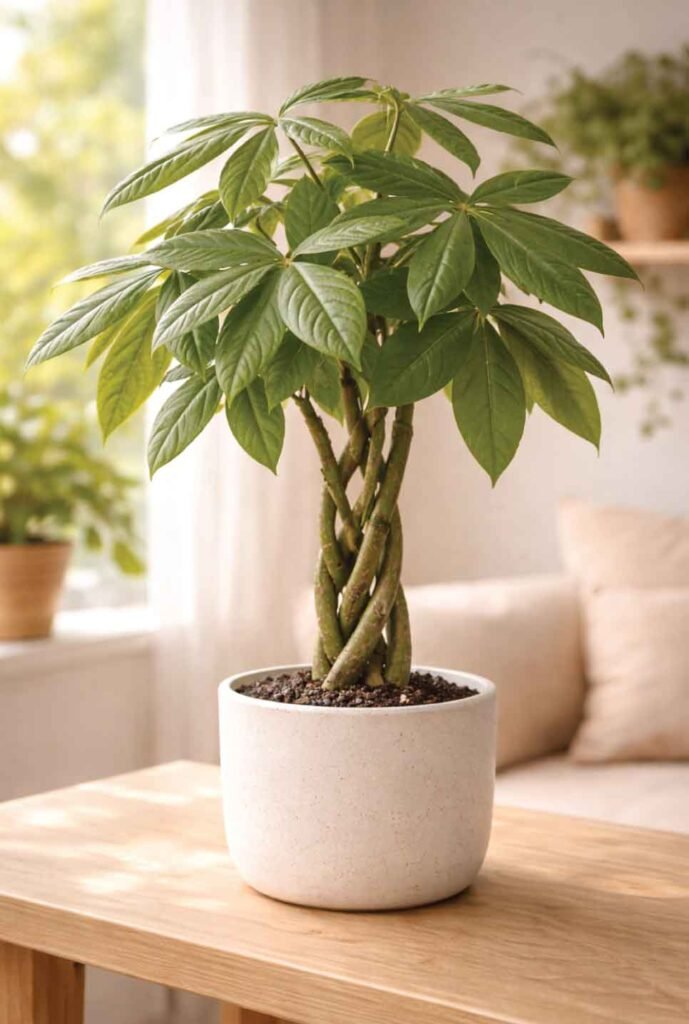
Money Tree (Pachira aquatica) The Texture Explorer
The money tree is one of those plants that looks really impressive and interesting, especially with its distinctive braided trunk. And here’s the good news: it’s completely safe for birds. Neither the leaves nor the bark contains toxins that could harm your feathered friend.
- Birds are often fascinated by the braided trunk texture. It provides something different to explore, climb on, and investigate. The leaves are glossy and tropical-looking, and while they’re safe if nibbled, they’re not particularly appealing as food to most birds. This can actually work in the plant’s favor, your bird might investigate but not destroy it immediately.
- But here’s where I need to give you a heads-up about the plant’s survival chances: large parrots can absolutely wreck a money tree. Those braided trunks that look so elegant? A determined macaw or African grey can strip the bark right off, and once that happens, the plant is basically doomed. The trunk can’t photosynthesize without its bark, and the plant will slowly decline and die.
- So, think about your bird’s personality and size before investing in a money tree. If you have smaller birds or birds who aren’t aggressive chewers, great! This could be a beautiful, long-lasting addition to your space. If you have a large parrot who views every object as something to dismantle, maybe appreciate money trees at someone else’s house instead. Or position it well out of reach where your bird can enjoy looking at it but can’t quite get their beak on it.
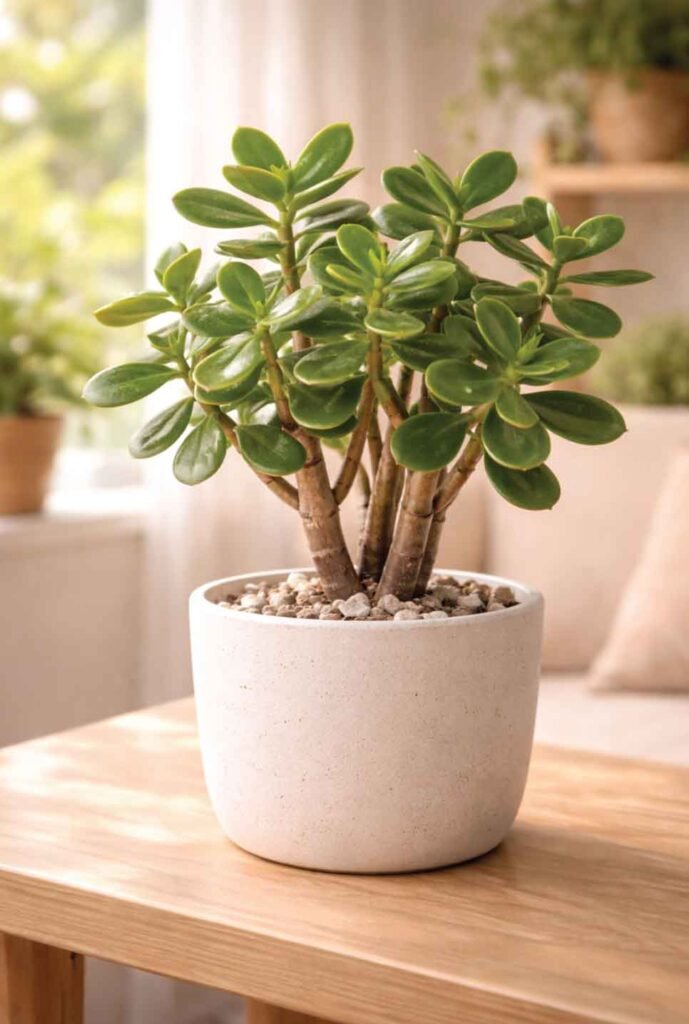
Jade Plant (Crassula ovata) The Hardy Succulent
Jade plants are wonderful for bird households, particularly if you’re looking for something low-maintenance that can take a beating. These thick-leaved succulents are completely safe for birds, and their structure makes them more resilient to beak damage than many leafy plants.
- The thick, fleshy leaves aren’t particularly fun to chew for most birds, they’re kind of rubbery and don’t shred in that satisfying way that soft leaves do. This works in your favor because it means the plant is more likely to survive living alongside your bird. Jades are also incredibly forgiving when it comes to care. They’re drought-tolerant, don’t mind being a bit neglected, and can handle a range of lighting conditions.
- One important note: stick with true jade plants (Crassula ovata) and avoid anything labeled as “Silver Jade” or other jade varieties. Some sources have flagged certain jade subspecies as questionable for birds, so when in doubt, go with the standard green jade plant that’s been well-documented as safe.
- Jade plants grow slowly, which means you won’t have to constantly trim and manage them, but it also means if your bird does significant damage, it’ll take a while to recover. They’re great for adding some greenery without the high-maintenance care requirements of tropical plants, and they fit well on shelves, windowsills, or tabletops where your bird might visit but doesn’t spend all their time.
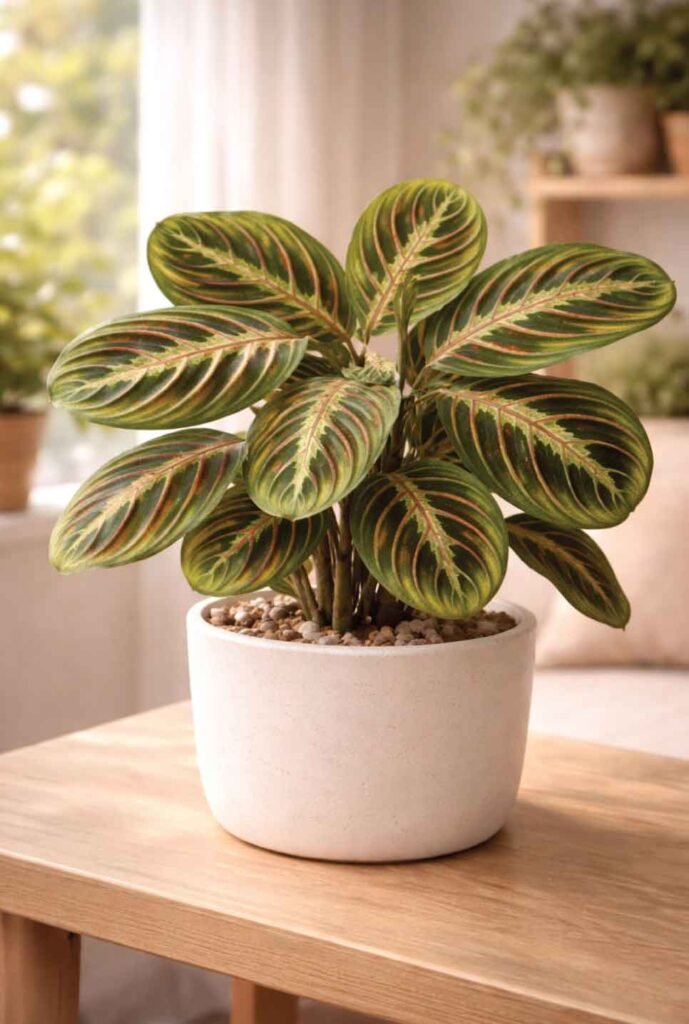
Prayer Plant (Maranta leuconeura) The Aesthetic Choice
Prayer plants are absolutely gorgeous with their striking leaf patterns and that cool trick where the leaves fold up at night like they’re praying (hence the name). They’re completely non-toxic, which means they’re safe to have around your bird, but I need to be straight with you about their limitations.
- These are delicate plants. If you have a bird who loves to shred, chew, and destroy foliage, a prayer plant will not survive. The leaves are thin and tear easily, and the plant won’t bounce back quickly from aggressive damage. This doesn’t mean you can’t have one, it just means you need to be strategic about placement.
- Think of prayer plants as visual pieces that you keep just slightly out of reach. Position them where your bird can see them and enjoy the visual interest, but can’t quite get their beak on them. Maybe on a high shelf, behind some barrier, or in a room where your bird visits but doesn’t have unsupervised access. This way, you get the beauty and the plant survives.
- Prayer plants do require some attention, they like consistent moisture, humidity, and indirect light, but they’re worth it for the stunning foliage. The leaves come in various patterns of green, red, and cream, and watching them fold up at night is genuinely cool. Just manage your expectations about direct bird interaction, and you’ll be fine.
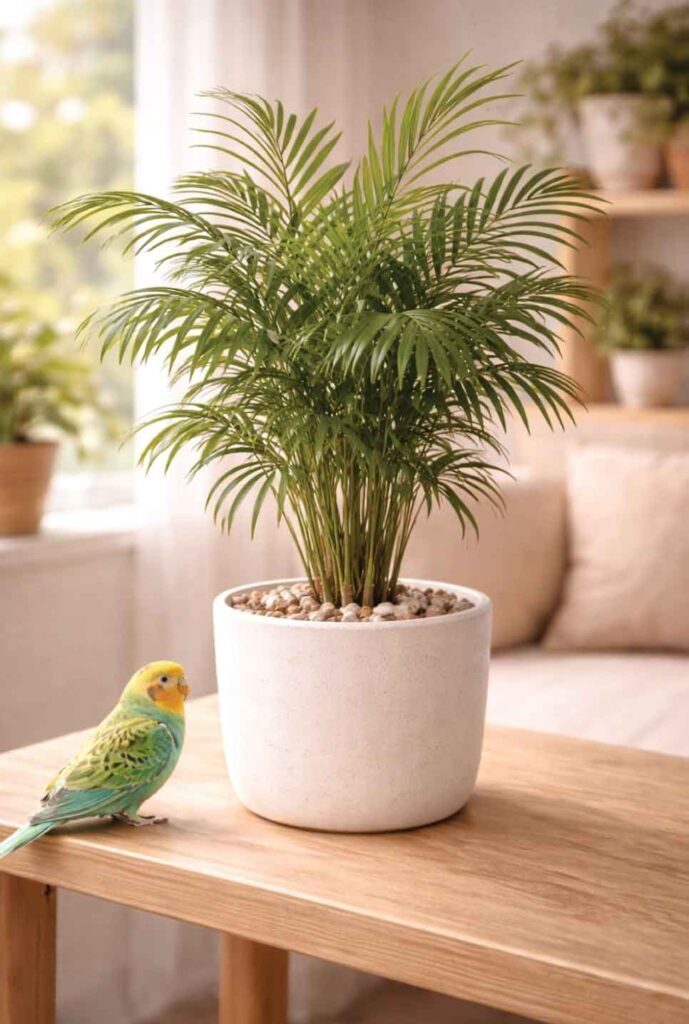
Parlor Palm (Chamaedorea elegans) The Slow Grower
Parlor palms are smaller cousins to the areca palm we talked about earlier, and they’re completely pet-friendly. These elegant little palms add a tropical feel to your space without taking over your entire living room, and they’re safe for birds to be around.
- The challenge with parlor palms is their growth rate, or rather, their lack of one. These plants grow very, very slowly. If you have a bird who’s a serious shredder, someone who views every plant as a personal challenge to turn into confetti, a parlor palm is not going to keep up with the damage. You’ll end up with a sad, naked stem that takes months or even years to recover.
- If your bird is more of a casual nibbler, or if you’re good about positioning the plant where it can be seen and appreciated but not completely demolished, parlor palms are lovely. They tolerate lower light conditions than many palms, they’re forgiving about watering, and they have a graceful appearance that adds sophistication to any space.
- Think about your specific situation before committing to a parlor palm. Are you okay with the possibility that your bird might do some damage that takes forever to grow back? Do you have a spot where the plant can be relatively protected? If the answer is yes, go for it. If you know your bird would strip it bare in an afternoon, maybe choose something higher on this list that can handle the abuse.
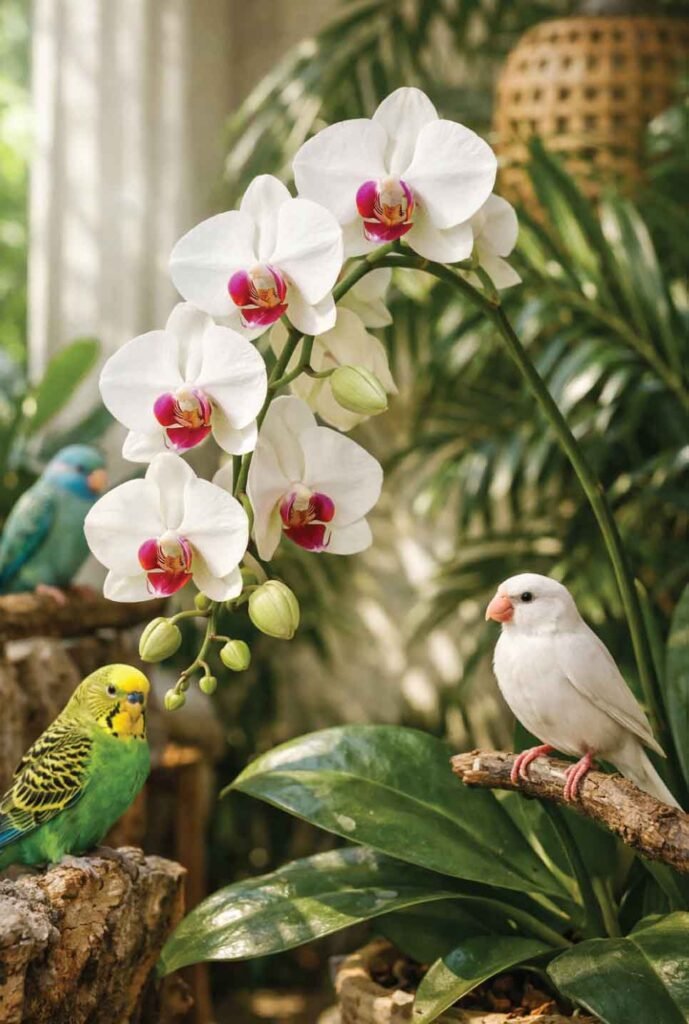
Phalaenopsis Orchids – The Elegant Decoration
Rounding out our list, we have the orchids, specifically Phalaenopsis orchids, those gorgeous moth orchids you see everywhere from grocery stores to fancy boutiques. Here’s the good news: they’re completely non-toxic to birds. Every part of the plant is safe, which is fantastic.
- Here’s the less good news: they’re ranked last on this list for a reason. Orchids are expensive (at least compared to most houseplants), and they’re incredibly easy to destroy. One curious beak can snap off a flower spike, tear delicate blooms, or damage the plant beyond recognition. If you’ve ever paid $30 to $50 for a beautiful orchid in full bloom, only to have it destroyed in minutes by your parrot, you’ll understand why these are ranked as “visual only” decor.
- That doesn’t mean you can’t have orchids in your bird household, it just means you need to be smart about it. Keep them well out of reach, maybe in a room where your bird doesn’t have access, or on a high shelf behind a protective barrier. Enjoy them for their elegance and sophistication, but don’t count on your bird being able to interact with them safely (safely for the plant, that is, your bird would be fine, but your wallet would be sad).
- Orchids also have specific care requirements that can be tricky if you’re not familiar with them. They need the right balance of light, water, and humidity, and they don’t bloom continuously. But when they do bloom, they’re absolutely stunning and can last for months with proper care. Just appreciate them from a distance where beaks can’t reach.
Crucial Safety Protocols: The “Hidden” Dangers You Need to Know About
Alright, here’s where things get serious for a minute. Even if you choose plants from the safe list above, there are hidden dangers that can turn a perfectly safe plant into a health hazard for your bird. Pay close attention to this section, it could literally save your bird’s life.
The Soil Trap
This is something a lot of new bird owners don’t think about, and it’s actually one of the biggest risks. That potting soil the plant comes in? It’s probably not safe for birds.
Most commercial potting soils contain ingredients that seem harmless but are actually dangerous:
- Perlite: Those little white bits you see mixed in? That’s often perlite, which is basically expanded volcanic glass. If your bird digs in the dirt (and many birds love to dig), they might ingest perlite, which can cause serious internal damage.
- Chemical fertilizers: Many potting soils contain slow-release fertilizer pellets that can be fatal if a curious bird eats them.
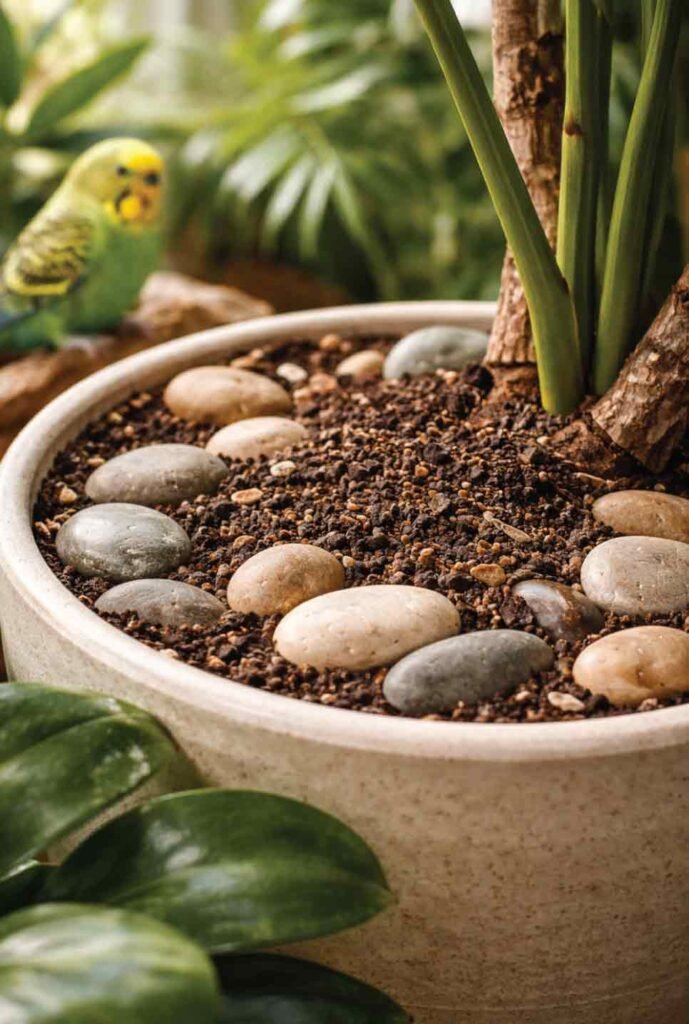
The solution: Repot every single new plant with organic potting soil specifically labeled as safe and free from chemical additives. Yes, this is extra work. Yes, it costs a bit more. But it’s absolutely worth it to eliminate this risk. While you’re at it, consider placing a barrier like large river rocks or a piece of bird-safe mesh over the soil surface to discourage digging altogether.
The Pesticide Rule
Here’s another thing that catches people off guard: plants from nurseries and garden centers are almost always treated with pesticides and other chemicals. These chemicals can linger on leaves for weeks or even months after application, and they can be seriously toxic to birds.
Before you let your bird anywhere near a new plant, you need to quarantine it. Here’s what to do:
- Keep the plant separate from your bird for at least a few weeks, preferably longer
- Wash the leaves thoroughly with lukewarm water and a tiny bit of mild, bird-safe soap (or just water if you prefer)
- Rinse well and let the plant go through several watering cycles to help flush out any systemic pesticides
I know this seems overly cautious, but remember what we talked about earlier, birds are exceptionally sensitive to toxins. What seems like trace amounts to us could be enough to make a bird seriously ill. Don’t skip this step, even if the plant looks clean and healthy. Those chemicals are invisible, and they’re not worth the risk.
Cleaning Natural Wood Branches
While we’re talking about bringing natural elements into your bird’s environment, let’s touch on branches from outside. Maybe you want to add some natural wood perches or decorative branches from your yard. Great idea for enrichment! But you absolutely must clean them properly first.
Natural wood can harbor bacteria, mold, parasites, and all sorts of nasty things your bird shouldn’t be exposed to. Here’s the proper protocol:
- Scrub thoroughly with hot water and detergent to remove dirt and debris
- Soak in dilute bleach solution (about 2 ounces of bleach per gallon of water) for 20 minutes to disinfect
- Rinse thoroughly with clean water
- Let dry completely before giving them to your bird
Some bird owners prefer to bake branches in the oven at a low temperature instead of using bleach, which is also effective. The key is making sure you’re killing any potential pathogens that could make your bird sick. Natural materials are wonderful for enrichment, but only when they’re properly prepared
Warning: Dangerous Lookalikes You Must Avoid
Now we need to talk about the plants that masquerade as safe but are actually dangerous. This is where things can go very wrong very fast if you’re not paying attention.
The “Lucky Bamboo” Trap
Remember when I emphasized getting true bamboo earlier? This is why. “Lucky Bamboo” is everywhere, you see it in water jars at checkout counters, in office buildings, at home goods stores. It looks harmless, it’s marketed as a low-maintenance good luck charm, and people assume bamboo is bamboo, right?
Wrong. Lucky Bamboo isn’t bamboo at all. It’s Dracaena sanderiana, a member of the Dracaena family, and it’s toxic to birds. If your bird chews on Lucky Bamboo, they could experience serious health problems including:
- Vomiting
- Dilated pupils
- Increased heart rate
- Abdominal pain
- In severe cases, death
The problem is that Lucky Bamboo looks similar enough to true bamboo that people confuse them, especially if they’re not familiar with plants. Here’s how to tell them apart:
- True bamboo: Woody, jointed stems with nodes; narrow, grasslike leaves; grows in soil
- Lucky Bamboo: Fleshy, smooth stems; broader leaves; usually sold growing in just water or with minimal soil
When in doubt, don’t buy it. If you can’t verify with absolute certainty that what you’re looking at is true Bambusa species bamboo, skip it and choose something else from the safe list. It’s not worth the risk. Avian veterinarians consistently warn about plants like Dracaena species, including Lucky Bamboo, which are documented as unsafe for birds by sources such as this toxic plant guide.
The Heavy Hitters: Never, Ever Allow These Near Your Bird
There are some plants that are so toxic to birds that they deserve special mention. These are the ones where even a small amount can cause severe illness or death. If you have any of these in your home, keep them in a completely separate area where your bird will never, ever have access, or better yet, don’t keep them at all.
Avocado
Is at the top of this list. Everything about the avocado plant is highly toxic to birds:
- The leaves
- The bark
- The fruit
- Even the pit
The toxin, called persin, causes cardiac distress, respiratory difficulty, and can kill a bird within 12 to 24 hours of exposure. If you have an avocado tree or even just buy avocados for your own consumption, be extremely careful about keeping any part of the plant away from your bird.
Dieffenbachia
(Commonly called Dumb Cane) is another serious threat. This popular houseplant contains calcium oxalate crystals that cause intense pain and swelling if ingested. In humans, it can temporarily prevent speech (hence “dumb” cane). In birds, it can cause severe swelling of the mouth and throat, difficulty breathing, and death.
Amaryllis
Is beautiful but deadly to birds. The bulbs are especially toxic, but all parts of the plant contain toxins that affect the gastrointestinal system, cause tremors, and can lead to death. These are common holiday plants, so be extra vigilant during gift-giving seasons when someone might bring you one without realizing the danger.
Other plants to absolutely avoid include:
- Philodendrons
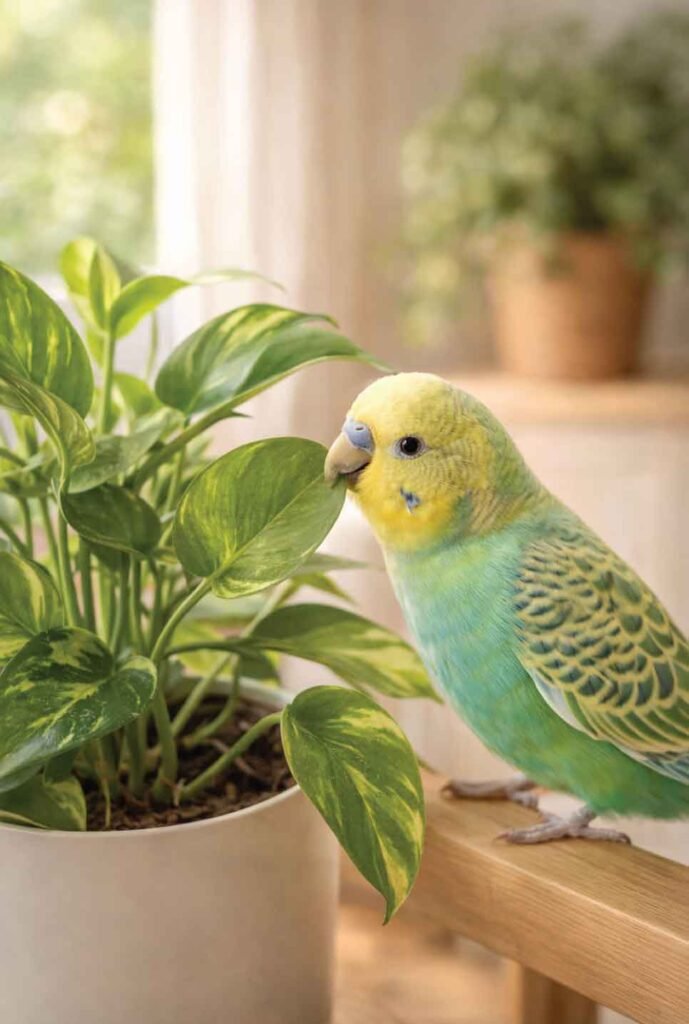
- Pothos (even though they’re incredibly popular houseplants)
- Oleander
- Azalea/Rhododendron
- Bird of Paradise (seeds & flowers)
- Calla Lily
- English Ivy and related Hedera species
- Lilies (Lilium spp., Hemerocallis spp.)
- Mistletoe (berries)
- Oleander
- Philodendron
- Pothos (Devil’s Ivy)
- Sago Palm/Cycad
- Tulip (bulbs)
- Yew (Taxus spp.)
- Any plant in the nightshade family
If you’re unsure about a plant, look it up before bringing it home. Better to spend five minutes researching than to risk your bird’s life.
Bird-safe houseplants: Frequently Asked Questions (FAQs)
Yes, they can. Some plants release pollen, sap, or airborne particles that may irritate a bird’s sensitive respiratory system, even without direct chewing. That’s why placement, airflow, and choosing truly bird-safe plants matter just as much as preventing nibbling.
It can still be risky. Many fertilizers release fumes or residue that linger on leaves or in the air, especially in warm indoor spaces. Even if your bird never reaches the pot, airborne exposure may cause irritation or illness. Organic, bird-safe alternatives are the safest choice.
Not always. Hanging plants can reduce direct access, but birds that fly freely often land on them anyway. A hanging plant is only safer if it’s both non-toxic and positioned where falling debris, soil, or leaves won’t be ingested.
In most cases, no. Artificial plants often contain dyes, plastic fibers, wire frames, and chemical coatings that can be dangerous if chewed. Even “decorative” faux plants pose choking or toxin risks, making real, verified bird-safe plants the better option.
They can. Bird-safe plants may offer mental stimulation, visual enrichment, humidity support, and gentle foraging opportunities, depending on the plant and placement. While they don’t replace toys or interaction, they can enhance a bird’s environment when used thoughtfully.
In some situations, yes. During molting, illness, or stress, birds may chew more or be more sensitive to environmental factors. Temporarily limiting access to plants can reduce risks while your bird’s immune system or energy levels are compromised.
Listen to the Podcast: Bird Safe Houseplants
Conclusion: Creating a Thriving Sanctuary for Your Feathered Friend
Choosing bird-safe plants isn’t just about checking items off a safety list, it’s about creating an enriching environment where your bird can thrive. When you bring safe plants into your home, you’re doing something really special: you’re giving your bird opportunities to explore textures, investigate new things, and engage with their environment in ways that mimic their natural habitat.
Think beyond just the plants on this list, too. Safe herbs like basil, mint, parsley, and cilantro can be grown in small pots and offered to your bird as fresh, edible enrichment. These add wonderful scents to your home, provide nutritional variety for your bird, and give them the satisfaction of foraging for their own food, something they’d naturally do in the wild.
The goal is to create layers of engagement in your bird’s environment. Maybe there’s a spider plant they can safely munch on, a Boston fern where they can hide and play, some fresh basil they can forage, and a prayer plant positioned just out of reach that provides visual interest. Each element adds something different, keeping your bird mentally stimulated and physically active.
Here’s my favorite analogy for bird-proofing your plant choices: think of your bird as a toddler with wings and a pair of pliers. Would you let a two-year-old put something in their mouth? No? Then don’t let your bird have access to it unless you’ve vetted it as safe. Birds are curious, clever, and completely lacking in judgment about what’s dangerous. It’s our job as their caretakers to make sure their environment is safe while still being interesting and engaging.
The effort you put into selecting safe plants pays off in so many ways:
- You get to enjoy the beauty and air-purifying benefits of houseplants
- Your bird gets enrichment, mental stimulation, and a more naturalistic environment
- Everyone’s healthier and happier
- You get the peace of mind knowing that your bird’s curiosity won’t lead to a veterinary emergency
So go ahead, bring some green into your bird’s world. Just do it smartly, thoughtfully, and with safety as your number one priority. Your feathered friend is counting on you to make good choices, and with the information in this guide, you’re well-equipped to create a beautiful, thriving sanctuary that keeps everyone safe and happy.