Quick Guide about How to Stop Puppy Biting
• Puppy biting is usually normal mouthing, play, teething, excitement, or overtiredness, not a sign that your puppy is “bad.”
• Redirect teeth to an appropriate toy, and calmly end attention when biting continues.
• Yelling, hitting, muzzle-grabbing, or other punishment can create fear without teaching your puppy what to do instead.
• Watch for stiff body language, guarding, fear, unusually intense bites, or sudden behavior changes that may need professional help.
Your puppy is adorable right up until those tiny needle teeth attach themselves to your hand, sleeve, ankle, or all three at once. If you’re wondering how to stop puppy biting without shouting, smacking, or turning every play session into a battle, the answer starts with teaching rather than punishing.
Most puppy mouthing is a normal part of development. Puppies explore with their mouths, play with their mouths, and chew more while teething. That doesn’t mean you have to spend the next several months serving as a human chew toy.
The goal isn’t to scare your puppy into keeping their mouth shut; it’s to make human skin boring and appropriate chewing much more rewarding.
Here’s how to do that in everyday life.
Stop Treating Normal Puppy Mouthing Like a Character Flaw
Puppies don’t arrive knowing that biting another puppy during play and putting the same pressure on human skin are two very different things. For most young puppies, mouthing is communication, exploration, play, and practice, not calculated aggression.
Teething can add another layer. As adult teeth develop, puppies naturally seek opportunities to chew, and fingers, shoelaces, dressing-gown belts, and moving trouser legs can be incredibly tempting targets.
The Blue Cross describes puppy mouthing and play biting as a normal developmental behavior and recommends managing it with appropriate toys, rest, supervision, and calm responses rather than frightening the puppy. Blue Cross: Puppy Biting and Mouthing
Understanding the reason behind the bite changes how you respond to it. Instead of asking, “How do I punish this?” ask, “What should my puppy be doing with their mouth instead?”
Start here:
- Keep suitable puppy-safe chew toys available in several rooms.
- Expect more chewing during teething.
- Avoid deliberately encouraging puppies to wrestle with bare hands.
- Notice when biting happens most often: during play, when tired, around food, when being handled, or during evening zoomies.
- Redirect early instead of waiting until your puppy is already wildly overexcited.
Put Something Better in Their Mouth Before They Choose You
Redirection sounds simple because it is, but timing matters. The best redirect happens before your puppy has spent five minutes successfully turning your forearm into their favorite tug toy.
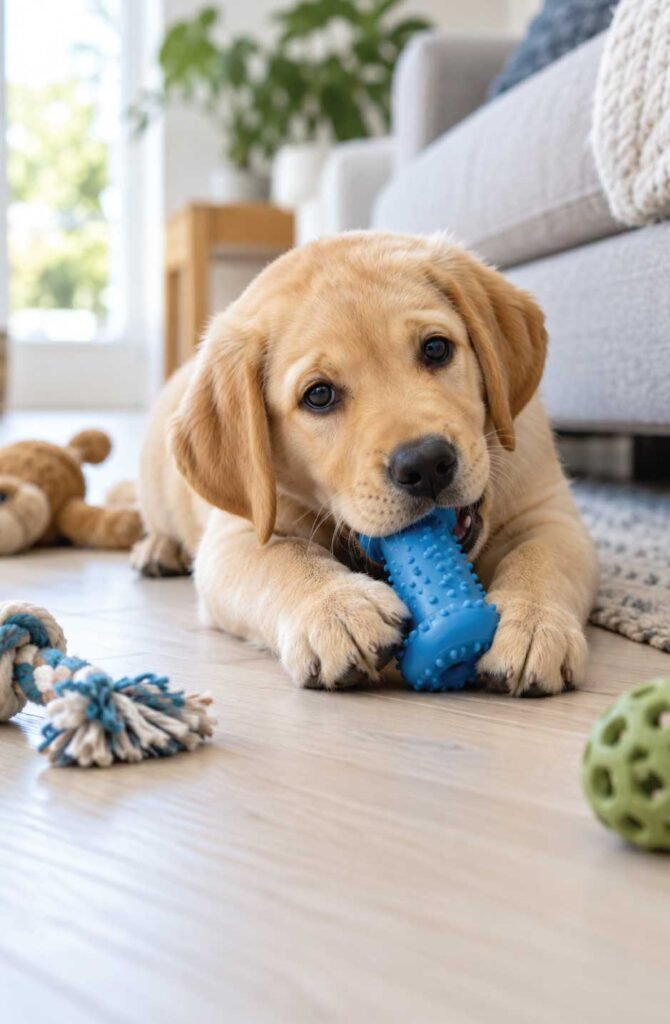
Keep an appropriate toy within reach during common biting situations. If your puppy approaches with that unmistakable open-mouth puppy enthusiasm, offer the toy and make that object interesting.
For example, if your puppy usually attacks your ankles when you walk across the kitchen, don’t wait until teeth hit your socks. Have a toy ready before you start moving.
You’re creating a predictable rule: toys are for teeth; people aren’t.
Make redirection easier by:
- Keeping one or two toys beside the sofa.
- Leaving a toy near the garden door.
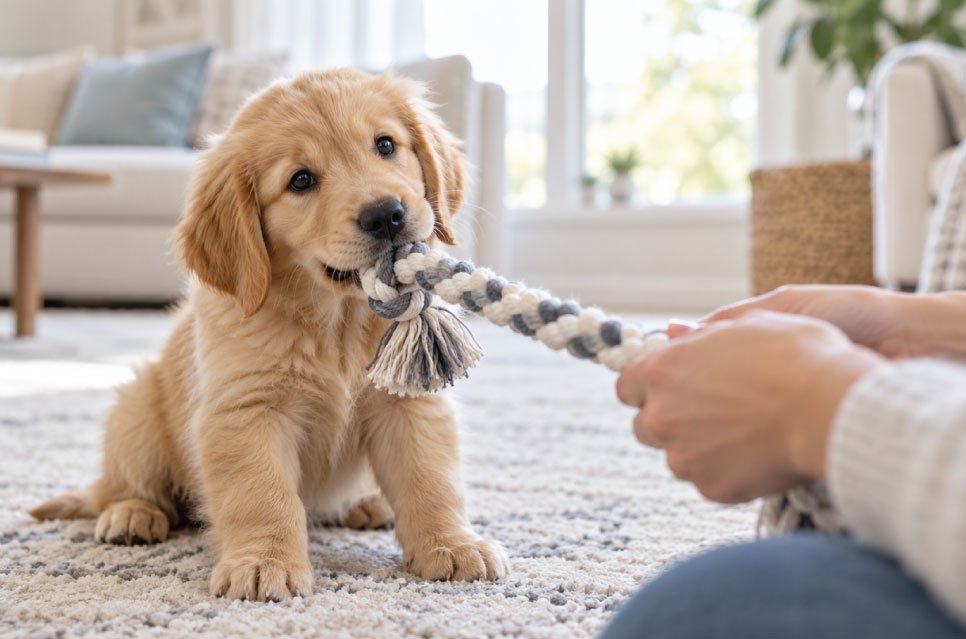
- Carrying an appropriate tug toy during active play.
- Rotating toys so the same objects don’t become boring.
- Using chew items suitable for your puppy’s size and chewing style.
Don’t wave your hands in your puppy’s face and then become surprised when they chase them. Fast-moving fingers can look like an invitation to play.
Set your puppy up to make the right choice instead of repeatedly testing their self-control.
When Teeth Touch Skin, Make the Fun Disappear
Puppies repeat behavior that works. If biting makes humans squeal, wave their arms, chase the puppy, wrestle harder, or provide exciting attention, the puppy may accidentally learn that biting people makes the party better.
Instead, make your response calm and predictable.
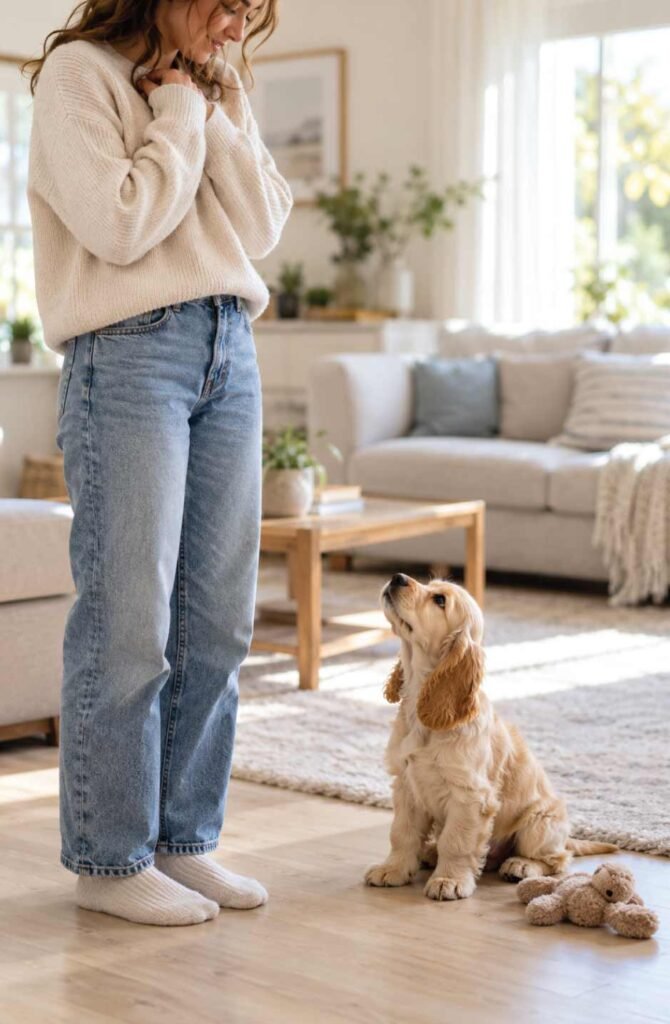
When teeth hit skin or clothing, pause the interaction. Tuck your hands away, stand still, turn away, or briefly move out of reach if necessary. Once your puppy is calmer, resume with an appropriate toy or another simple activity.
Biting should make exciting interaction stop, not start a louder game.
A short sequence might look like this:
- Puppy bites your hand.
- You stop moving and disengage.
- Puppy releases.
- You offer an appropriate toy or restart calm interaction.
- Puppy bites hard again.
- You calmly end the interaction for a brief moment.
Some traditional advice suggests making a high-pitched “ouch” or yelp. That response may interrupt some puppies, but if your puppy becomes more excited when you squeal, skip it. You do not need to impersonate an injured littermate for this training to work.
Consistency matters more than drama.
Skip the Shouting, Nose Taps, and “Show Them Who’s Boss” Advice
When puppy teeth hurt, frustration is understandable. But physical or intimidating corrections can stop behavior in the moment while creating fear, anxiety, avoidance, or defensive responses you never wanted.
That means avoiding things such as:
- Smacking or tapping the puppy.
- Holding the muzzle shut.
- Pinning or “alpha rolling” the puppy.
- Shouting in their face.
- Scruff shaking.
- Deliberately frightening them.
- Using pain-based training tools to address mouthing.
The American Veterinary Society of Animal Behavior recommends reward-based methods for dog training and advises against aversive methods involving pain, fear, intimidation, or physical correction. AVSAB Humane Dog Training Guidance
Reward-based training doesn’t mean letting your puppy do whatever they want. You can have clear boundaries: biting makes play stop, calm behavior earns attention, and appropriate chewing gets rewarded.
That is still discipline, just without making your puppy afraid of you.

If Your Puppy Turns Into a Shark at Night, Check the Sleep Situation
If biting seems manageable all morning and then becomes spectacularly terrible after dinner, your puppy may be overtired or overstimulated rather than desperately in need of another hour of exercise.
Overtired puppies don’t always lie down and look sleepy. They may sprint, jump, bark, grab clothes, bite harder, ignore familiar cues, and bounce rapidly from one forbidden activity to another.
Sound familiar?
Your puppy may be entering the puppy witching hour. I have a complete guide to recognizing and managing that evening chaos here: Puppy Witching Hour: Why Your Puppy Goes Crazy at Night.
When biting suddenly becomes harder and more frantic, ask whether your puppy needs less stimulation rather than more.
Try:
- A calm toilet break.
- Lowering household activity.
- Swapping rough play for sniffing or chewing.
- Offering an appropriate chew in a quiet area.
- Giving your puppy an opportunity to rest.
- Starting the evening wind-down before the usual biting frenzy begins.
A puppy who falls asleep shortly afterward has given you a pretty strong clue.
Teach Behaviors That Can’t Happen at the Same Time as Biting
“Don’t bite” doesn’t tell a puppy what you actually want. Training becomes much clearer when you give your puppy an alternative behavior that can earn the thing they wanted.
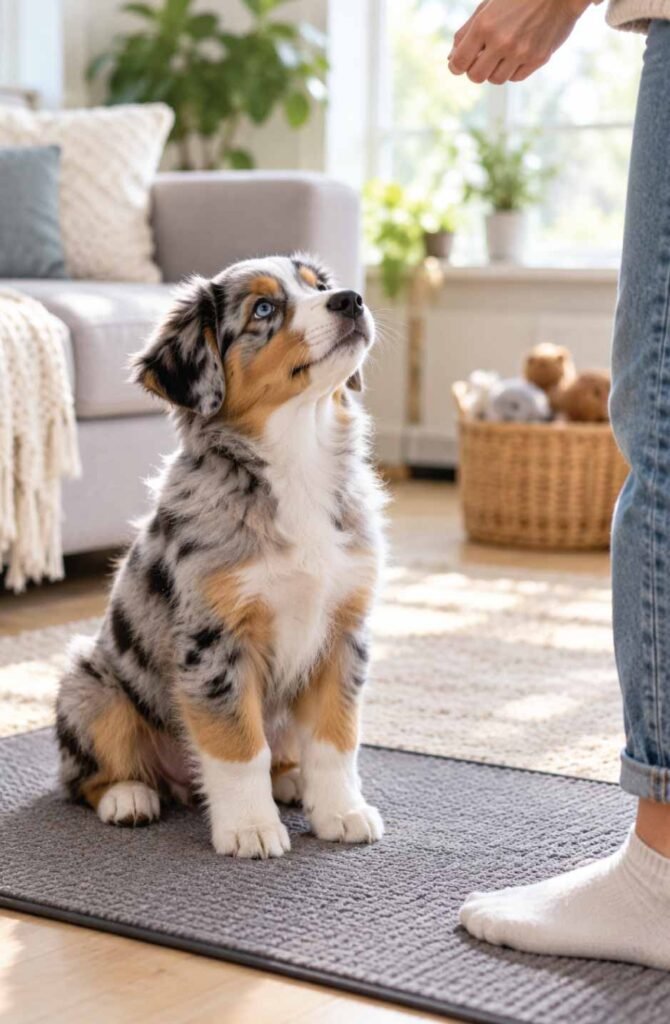
If your puppy jumps and mouths when they want attention, teach them that sitting calmly makes attention appear.
If they bite while you’re clipping on the lead, reward them for keeping four paws down while you handle the equipment.
If hands automatically trigger teeth, practice calm, very short interactions when your puppy is relaxed rather than overexcited.
Useful alternatives include:
- Sit for attention.
- Touch your hand with the nose.
- Go to a mat.
- Carry a toy during greetings.
- Chew an appropriate item while relaxing near you.
- Briefly focus on a simple cue for a food reward.
Reward the behavior you want to see before biting happens whenever possible.
This is also where understanding your puppy’s signals becomes incredibly useful. If you’re not sure whether the puppy approaching you is playful, worried, frustrated, or uncomfortable, read How to Read Dog Body Language: 7 Silent Signs You Are Missing.
Manage Puppy Biting Around Children Differently
Children run, squeal, wave their arms, drop toys, and react dramatically when sharp teeth connect. From a puppy’s perspective, a running child can accidentally become the most exciting interactive toy in the house.
Young children should not be expected to train a biting puppy themselves.
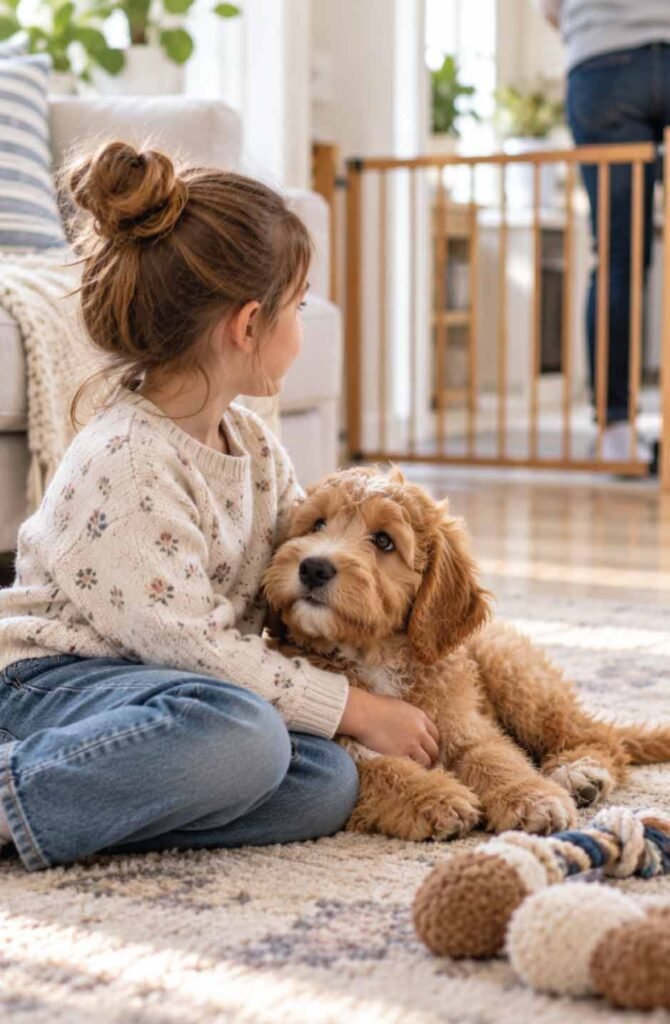
Use adult supervision and physical management such as gates, pens, or separate safe areas when you cannot actively supervise. If the puppy becomes too excited, separate puppy and child calmly rather than repeatedly telling both of them to “be nice.”
Teach children simple rules appropriate for their age:
- Don’t encourage the puppy to chase hands or feet.
- Don’t take chews or food away from the puppy.
- Don’t disturb a sleeping puppy.
- Don’t run from a puppy who is already chasing and mouthing.
- Call an adult when play becomes uncomfortable.
Management prevents both the puppy and child from practicing interactions that are unsafe or frightening.
For broader routines, socialization, health, and training foundations for a new dog, see Dog Care Tips for Beginners: Care, Health and Behavior.

When Is Puppy Biting More Than Normal Play?
Most puppy mouthing improves with maturity, consistent training, appropriate chewing outlets, and better management. But not every bite should automatically be dismissed as “just puppy behavior.”
Pay particular attention to the context and body language.
Seek veterinary or qualified behavior help if you notice:
- Stiffening or freezing before biting.
- Guarding food, toys, resting places, or stolen objects.
- Growling accompanied by tense, defensive body language.
- Biting specifically when touched in one area of the body.
- Sudden new biting from a puppy who previously tolerated handling.
- Bites that seem connected with fear rather than play.
- Repeated bites that cause significant injury.
- Behavior that is becoming more intense despite careful management.
Sudden behavioral changes can sometimes be associated with pain or another medical issue, so your veterinarian should be your first stop when biting appears unexpectedly or alongside physical symptoms.
And if you’re struggling, getting professional help isn’t admitting defeat. Good puppy training is much easier when somebody can watch the exact behavior, environment, timing, and human response instead of trying to diagnose everything from a description online.
The Secret Sauce
Put “Bite Stations” Around Your Home
Most owners have plenty of puppy toys. Unfortunately, those toys are usually six meters away when the puppy attaches themselves to a trouser leg.
Strategically placing toys where biting normally happens makes successful redirection much easier.
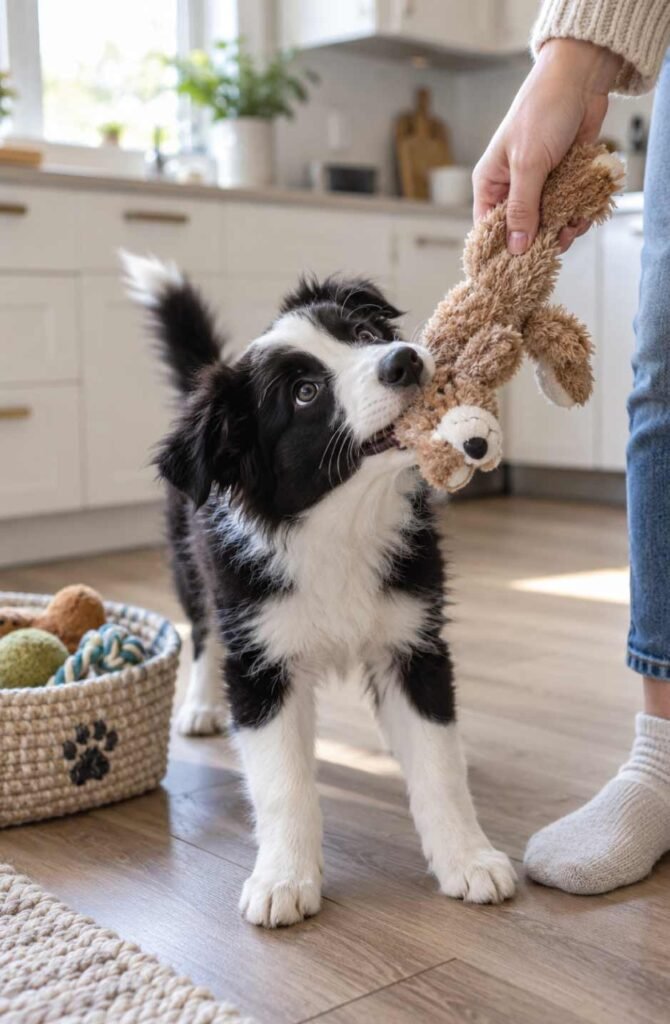
Keep a small toy basket near the sofa, kitchen, garden entrance, or anywhere else your puppy frequently becomes mouthy. You’ll spend less time saying “no” while searching under furniture for something appropriate.
Reward the Five Seconds Before the Bite
We tend to notice puppies when they’re doing something annoying. Start noticing the brief moments when your puppy is making excellent choices without being asked.
Puppy lying beside you instead of biting? Quietly reward them.
Puppy approaches and sits instead of launching at your sleeves? Reward them.
Puppy chooses a chew instead of your shoe? Reward that too.
You’re making desirable behavior more valuable before the problem starts.
Keep a Three-Day Bite Diary
If it feels like your puppy bites “constantly,” write down every major biting episode for three days. Patterns often appear remarkably quickly.
Record:
- Time of day.
- What happened immediately beforehand.
- How long the puppy had been awake.
- Whether food or a toilet break was due.
- Type of play happening.
- People involved.
- Whether your puppy settled afterward.
You might discover that 70 percent of the worst biting happens after long periods without sleep, during children’s playtime, or immediately before dinner.
Once you know the trigger, prevention becomes far easier.
Frequently Asked Questions about How to Stop Puppy Biting
Most puppies gradually become less mouthy as they mature, finish teething, and learn better bite control, but there is no exact age when biting suddenly stops.
Adult teeth are generally in place by around six to seven months, so teething-related chewing should begin to decrease around this stage. However, playful biting can continue if the puppy has learned that nipping reliably creates attention or exciting interaction.
Training still matters even after teething ends. Consistently rewarding appropriate chewing and calm interactions helps prevent puppy mouthing from becoming a long-term habit.
Yes, some owners notice that puppy biting temporarily becomes more intense during teething or periods of rapid development.
Your puppy may suddenly become more interested in chewing as adult teeth begin coming through. Changes in confidence, energy levels, daily routines, or excitement can also make mouthing seem worse for a while.
A temporary increase doesn't necessarily mean your training has failed. Look at the overall trend across several weeks rather than judging progress based on one especially toothy afternoon.
Breed tendencies can influence how strongly a puppy enjoys grabbing, carrying, chasing, or using their mouth, but every puppy is an individual.
Retrievers, herding breeds, and other dogs selectively bred for jobs involving carrying or controlling movement may naturally use their mouths frequently during play. That doesn't mean owners should accept painful biting.
Instead, provide appropriate outlets that fit the puppy's instincts, such as retrieving toys, tug games with clear rules, food puzzles, sniffing activities, and reward-based training.
Plain ice may feel soothing to some teething puppies, but very hard frozen objects aren't automatically the safest choice for every dog.
Aggressive chewing on extremely hard items can potentially damage teeth. Safer options may include puppy-specific teething toys that have been chilled according to the manufacturer's instructions or veterinarian-approved chew items appropriate for your puppy's size.
Always supervise chewing and remove anything that begins breaking into pieces your puppy could swallow.
A pet-safe taste deterrent may discourage chewing on some objects, but it shouldn't replace supervision, management, and teaching your puppy what they are allowed to chew.
Some puppies dislike bitter sprays immediately, while others barely seem to notice them. If you use one, choose a product specifically designed for pets and follow its directions carefully.
More importantly, block access to valuable or dangerous objects and place appropriate chew toys nearby. Preventing repeated furniture chewing is usually easier than trying to undo a well-practiced habit later.
A well-managed game of tug does not automatically teach a puppy to bite people and can actually provide an appropriate outlet for natural grabbing behavior.
The important distinction is what the puppy is allowed to bite. Teeth should stay on the toy rather than hands, clothing, or skin.
Use a reasonably long toy that gives your hands some distance from puppy teeth. Pause the game if teeth repeatedly make contact with you, and restart once your puppy is able to engage appropriately.
Tug can also become a useful training game by teaching cues such as “take it,” “drop,” and waiting briefly before the game begins.
Less Fighting, More Teaching
Puppy biting can make even a patient owner question their life choices, especially when those tiny teeth find the exact same scratch from yesterday. But most puppy mouthing isn’t a battle for control; it’s a young dog learning what is appropriate to bite, how hard is too hard, and how to manage excitement.
Your job is to make the lesson extremely consistent:
Skin makes play stop. Toys keep play going. Calm behavior gets rewarded. Rest happens before exhaustion turns into chaos.
Redirect early, manage the environment, protect children from overly rough interactions, and give your puppy plenty of appropriate opportunities to chew.
You don’t need yelling, fear, or physical punishment to create boundaries. Clear consequences and reward-based teaching can show your puppy exactly what works without damaging the trust you’re building together.
And remember that progress probably won’t look like “my puppy never used their teeth again after Tuesday.” You may have great days followed by evenings when your puppy apparently decides to audition for Jaws.
Consistency wins.
Pin this for later so you have the steps ready the next time puppy teeth appear.
And if the worst biting happens after dinner, read Puppy Witching Hour: Why Your Puppy Goes Crazy at Night next. Your little land shark may be telling you they’re ready for sleep, not another round of fetch.