
At PetSweetJoy, we sometimes share products we truly love and use with our own pets. This post contains affiliate links, which means we may earn a small commission, at no extra cost to you. We only recommend products that fit our values of care, comfort, and responsible pet parenting.💗
Quick Guide: High-Style, Pet-Friendly Living
- Invest in the “Gold Standard” Fabric: Switch from hair-trapping velvets and snag-prone linens to high-quality leather. Leather is naturally antimicrobial, doesn’t harbor allergens or odors, and develops a beautiful patina over time. Best of all, it offers a “wipe-and-go” lifestyle for muddy paws.
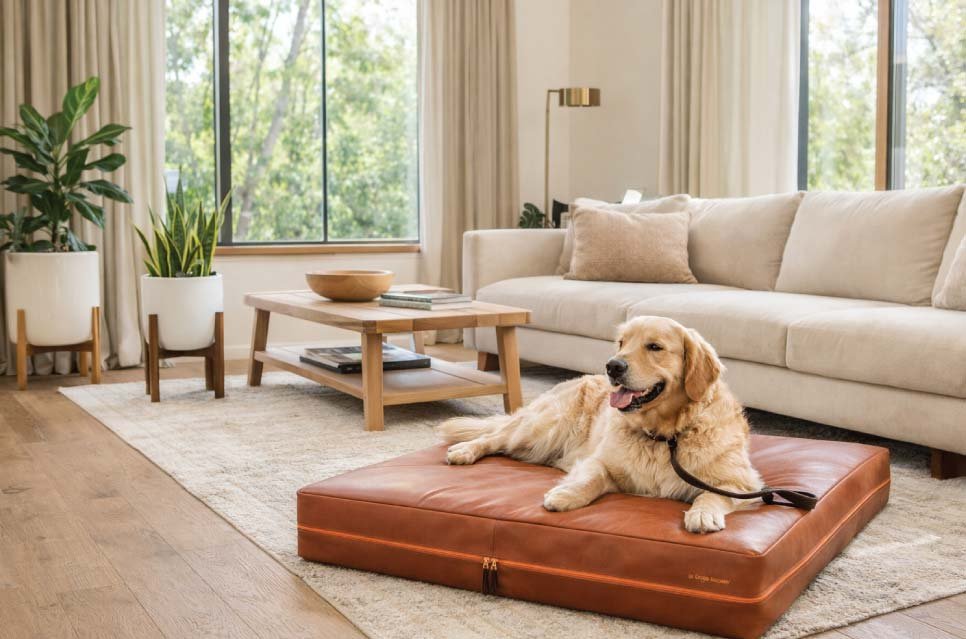
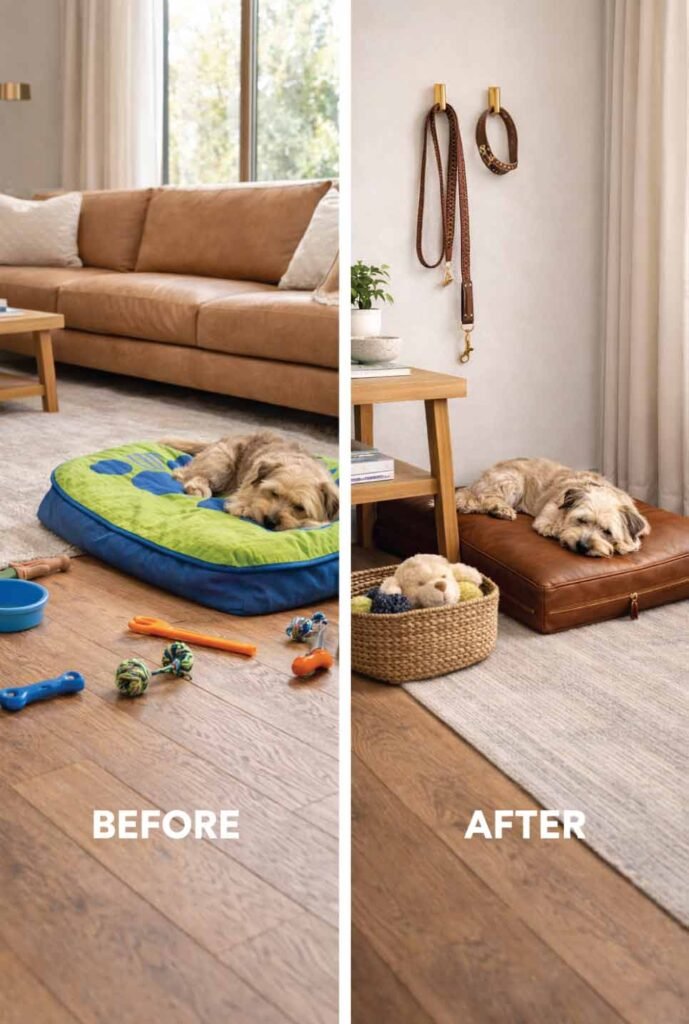
- Treat the Dog Bed as Furniture: Replace bulky, garish fabric beds with structured orthopedic leather beds. Look for minimalist designs that provide medical-grade joint support while mirroring the lines of your existing furniture. This allows the bed to sit in the center of the room rather than being hidden in a corner.
- Use Strategic Color Theory: Instead of hiding from shedding, use warm neutrals (cognac, taupe, camel, or greige) that match the “temperature” of your dog’s coat. These tones camouflage fur and wear patterns far better than stark white or dark charcoal, keeping the room looking pristine between cleanings.
- Curate the “Walk Station”: Eliminate visual clutter at your entryway by swapping neon nylon leashes and plastic bins for leather walking accessories and natural fiber baskets (like seagrass or jute). When your gear looks like high-end fashion, it becomes a design accent rather than an eyesore.
Introduction: The Myth of the “Messy Dog Home”
Let’s be honest, you’ve been there. You’ve spent months curating the perfect Dog-Friendly Living Room. The sofa? A carefully selected piece that cost more than your first car. The throw pillows? Artfully arranged in complementary neutrals. The coffee table books? Positioned just so. And then your beloved four-legged family member bounds into the room, and suddenly there’s a neon-green fabric bed in the corner, plastic toys scattered across your pristine rug, and that smell, you know the one, that lingers no matter how many candles you light.
Here’s the truth that the home decor magazines won’t tell you: “pet-friendly” doesn’t have to mean “plastic-heavy” or “aesthetic nightmare.”
The transformation from chaotic dog household to Pinterest-worthy sanctuary isn’t about choosing between your dog’s comfort and your design standards, it’s about making smarter, more intentional choices about the materials, colors, and furniture pieces you bring into your home. Your dog deserves a space that supports their health and comfort. You deserve a home that feels like the sanctuary you’ve worked hard to create. And the beautiful secret? You can have both. That includes understanding their daily needs, especially if you’re still learning the basics of caring for a dog at home.
This guide will show you exactly how to design a living room that serves your aesthetic vision while prioritizing your dog’s well-being, no more hiding the dog bed when guests come over, no more apologizing for the “pet smell,” and no more feeling like you have to choose between being a dog parent and having a beautiful home.
Listen to the Podcast: Dog-Friendly Living Room Style
The Foundation: Choosing “Pet-Proof” Luxury Fabrics
Before we talk about dog beds and accessories, let’s address the elephant (or should we say, the shedding Golden Retriever) in the room: your existing furniture fabric choices can make or break your pet-friendly design goals.
The Pitfalls of Traditional Fabric
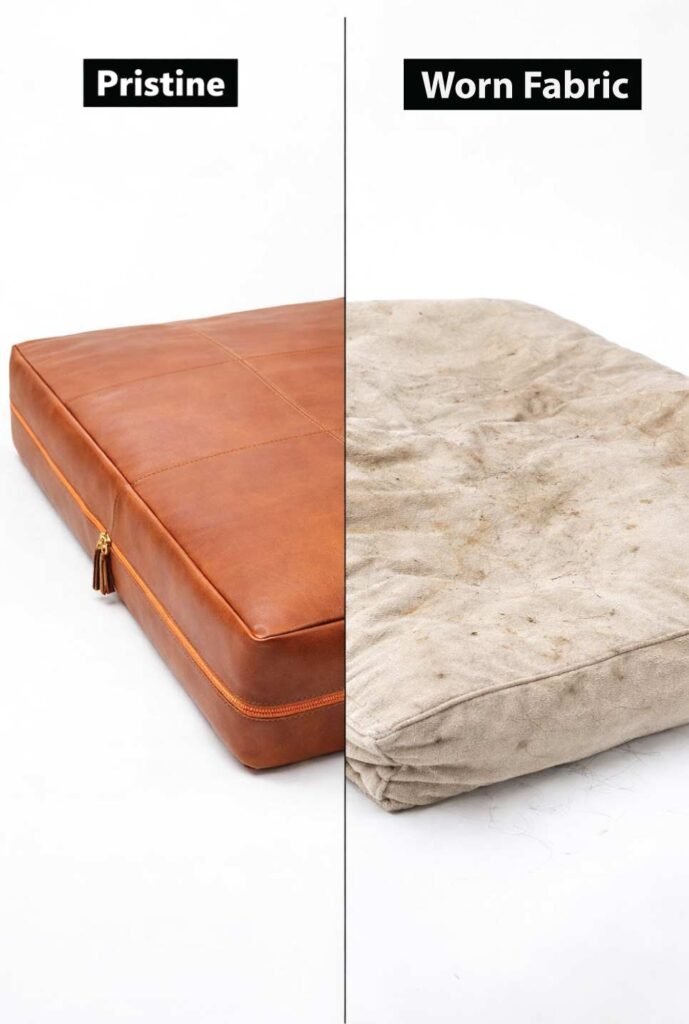
If you’re currently sitting on a velvet sofa wondering why you can never quite get all the dog hair off, you’re not alone. Velvet, despite its luxurious appearance, is essentially a hair magnet with a designer price tag. The dense pile that makes velvet feel so sumptuous also creates the perfect trap for every strand of fur your dog sheds. And don’t even get me started on cheap linen, yes, it photographs beautifully in those minimalist Scandinavian interiors, but one enthusiastic scratch from your pup’s paws and you’re looking at pulls, snags, and frayed edges.
Traditional upholstery fabrics fail dog owners in three critical ways:
- They trap allergens and dander deep in the fibers, creating a perpetual cycle of cleaning that never quite eliminates that telltale “dog smell”
- They show wear and tear quickly, especially in high-traffic areas where your dog loves to curl up
- They require intensive maintenance, professional cleaning, specialized treatments, and constant vacuuming that still doesn’t quite do the job
The Gold Standard: Leather
Enter leather, and I’m not talking about the stiff, uncomfortable leather of your grandfather’s office chair. High-quality, properly treated leather is the secret weapon of design-savvy dog owners who refuse to compromise on either style or practicality.
Why leather outperforms every other option for pet owners:
Durability That Gets Better With Age
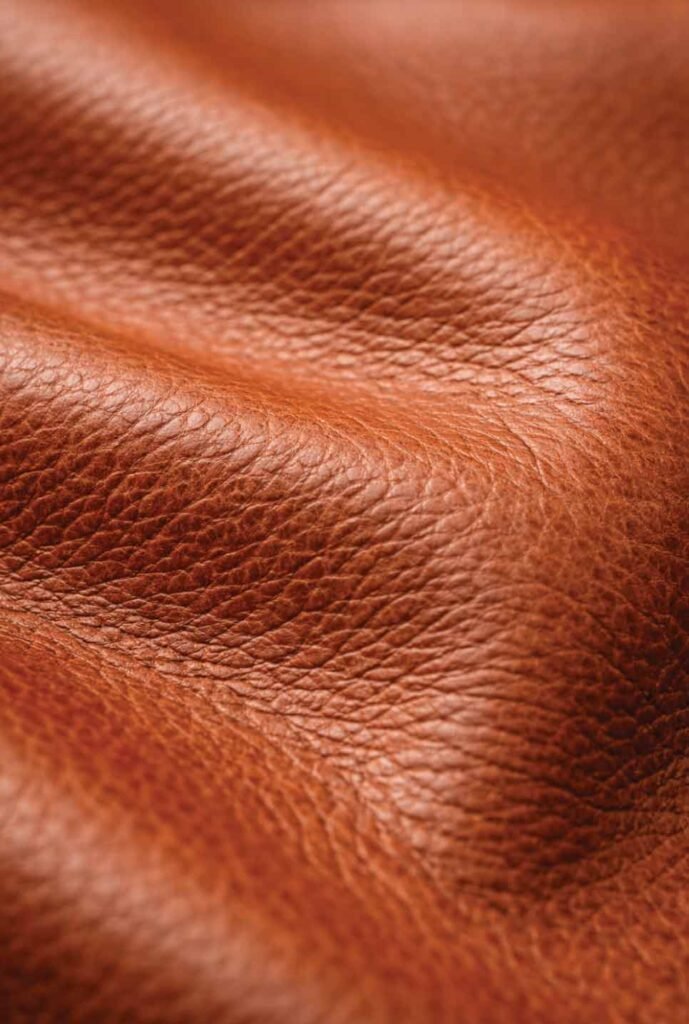
Unlike fabric that pills, fades, and wears thin, quality leather (like the Italian leather used by Le Dog Company) develops a rich patina over time. Those small scratches and marks? They add character rather than looking like damage. Think of leather like a good pair of boots, it doesn’t just survive daily wear, it becomes more beautiful because of it.
The Hygiene Factor You Can’t Ignore
Here’s something most people don’t realize: leather is naturally antimicrobial and doesn’t harbor the allergens, dander, and bacteria that fabric does. While your fabric sofa is essentially a three-dimensional petri dish collecting months of microscopic debris, leather surfaces can be wiped clean, leaving nothing behind. This is particularly crucial for households with family members who have allergies or sensitivities.
The “Wipe and Go” Lifestyle
Picture this: your dog comes in from a muddy walk and immediately flops onto their bed before you can stop them. With a fabric bed, you’re looking at removing the cover, pre-treating stains, running a wash cycle, waiting for it to dry, and wrestling the cover back on (why do they never fit quite right after washing?). With a leather surface, you grab a damp cloth, wipe it down, and you’re done in 30 seconds. The time you save on laundry alone is worth the investment.
Other Texture Considerations
While leather is the gold standard, other materials can complement your pet-friendly design strategy:
- Performance fabrics (like Crypton or Sunbrella) offer some of the wipeable benefits of leather with more color options
- Indoor/outdoor rugs in natural fibers like jute or sisal disguise dirt and are easy to clean
- Tight-weave materials with low pile prevent claws from snagging
The key is choosing intentionally rather than hoping that standard retail fabrics will somehow perform better than they’re designed to.
The Centerpiece: Upgrading the Dog Bed to a Furniture Piece
Now let’s talk about the element that usually screams “DOG HOUSE” louder than anything else: the dog bed.
Why Most Dog Beds Are Design Eyesores
Walk into any pet store and you’ll find the same depressing selection: puffy fabric beds in garish colors, beds with cartoon paw prints, or massive shapeless pillows that look like deflated bean bags. These beds are designed to appeal to impulse shoppers, not to actually integrate into a thoughtfully designed living space. They’re bulky, they lose their shape within months, and they inevitably end up shoved in the most inconspicuous corner you can find, which is exactly where your dog doesn’t want to be.
Your dog doesn’t want to be banished to the corner. They want to be near you, in the flow of family life, watching everything that happens. But traditional dog beds are so visually disruptive that we unconsciously push them out of sight, which defeats the entire purpose.
The Orthopedic Importance: More Than Just Comfort
Before we discuss aesthetics, let’s talk about why your dog’s bed actually matters for their long-term health, because this isn’t just about looks.
Canine joint health is often overlooked until there’s a problem.
Hip dysplasia affects approximately 20% of dogs (and up to 70% of certain breeds like German Shepherds and Golden Retrievers). Arthritis develops in 80% of dogs over the age of eight. These aren’t rare conditions, they’re the norm as dogs age. And one of the most impactful preventive measures you can take is providing proper orthopedic support during sleep. Keeping dogs mentally and physically balanced throughout the day also plays a big role in how their bodies age.
Dogs sleep 12-14 hours a day (more for puppies and seniors).
That means they spend more than half their lives on their bed. If that bed is a flat fabric cushion that compresses to nothing within months, or worse, if they’re sleeping on your hardwood floors, you’re setting them up for joint pain, pressure sores, and decreased mobility as they age.
Quality orthopedic support means:
- Memory foam or high-density foam that distributes weight evenly and prevents pressure points
- Proper cushioning that doesn’t flatten out after a few months of use
- Support that helps maintain proper spinal alignment during sleep
This is where the investment in a premium bed pays dividends, not just in aesthetic cohesion, but in your dog’s quality of life.
The Le Bed: Where Furniture Design Meets Canine Orthopedics
This is where we need to talk about what makes a truly exceptional dog bed, and why Le Dog Company’s Le Bed has become the go-to choice for design-conscious dog owners.
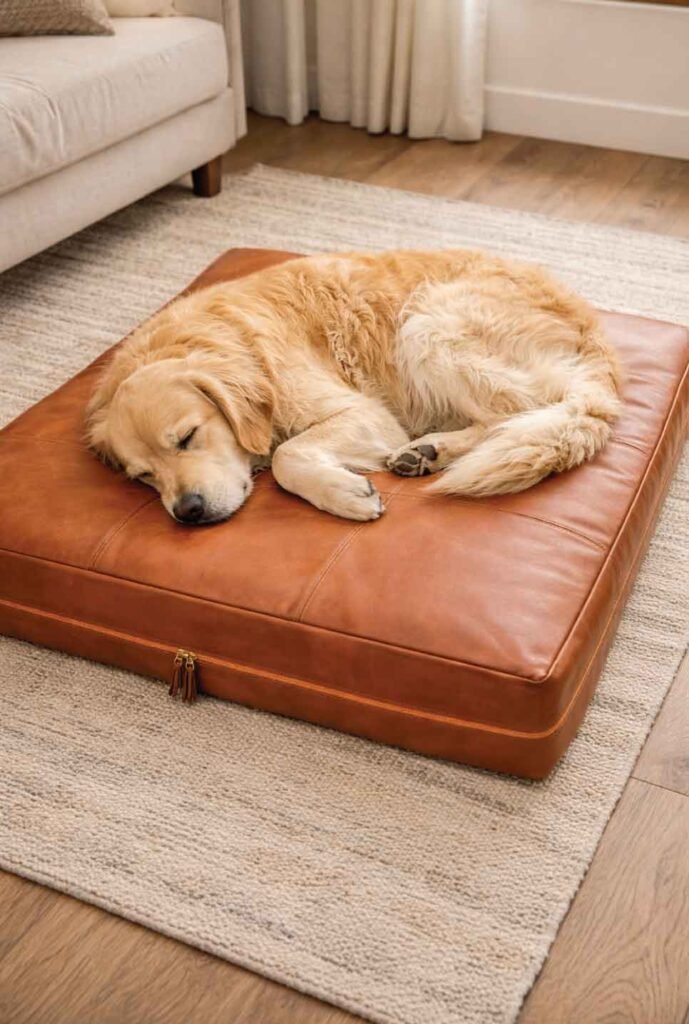
At first glance, the Le Bed doesn’t look like a dog bed at all, it looks like a piece of mid-century modern furniture. The clean lines, the structured silhouette, the high-quality leather upholstery, it could easily be an ottoman or a low bench in a boutique hotel lobby. This is intentional design at its finest.
But the magic is in the details:
- The Italian leather exterior provides that wipeable, hygienic surface we discussed earlier, but it’s also incredibly soft and supple, your dog will actually want to sleep on it. The leather is available in sophisticated colorways like Cognac, Black, Bone, and Slate Grey that coordinate with virtually any design scheme.
- The orthopedic foam core provides the medical-grade support your dog needs without the bulk and shapelessness of traditional dog beds. It maintains its structure and support year after year, which means you’re not replacing it every season like those $40 fabric beds from the pet store.
- Pro Design Tip: Match the leather tone of your dog bed to your existing furniture for seamless integration. If you have mid-century modern pieces with warm wood tones, the Cognac leather creates a cohesive color story. For contemporary spaces with black metal accents, the Black or Slate Grey options disappear into the design rather than fighting against it. The Bone shade is perfect for Scandinavian or coastal-inspired spaces with light, airy palettes.
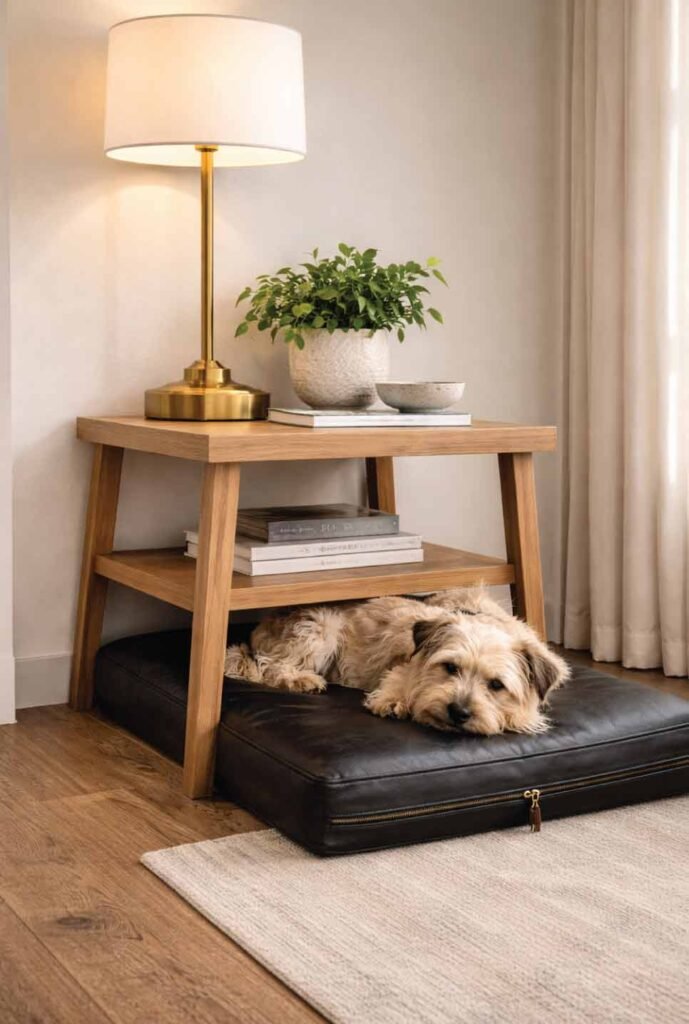
- The real genius? You can place the Le Bed anywhere in your living room without disrupting the design flow. Next to the sofa, underneath a console table, in front of the fireplace, it reads as furniture, not as pet gear. Your dog gets to be where they want to be (near you), and your living room maintains its carefully curated aesthetic.
Color Theory for Dog Owners: The Science of Camouflage
Let’s address the shedding situation head-on, because pretending it doesn’t happen isn’t a design strategy.
Camouflaging the Shed Without Surrendering to Grey
The conventional wisdom says that dog owners should paint everything grey or beige and call it a day. But that’s boring, and more importantly, it’s not necessary if you understand basic color theory as it applies to pet ownership.
Here’s the strategic approach:
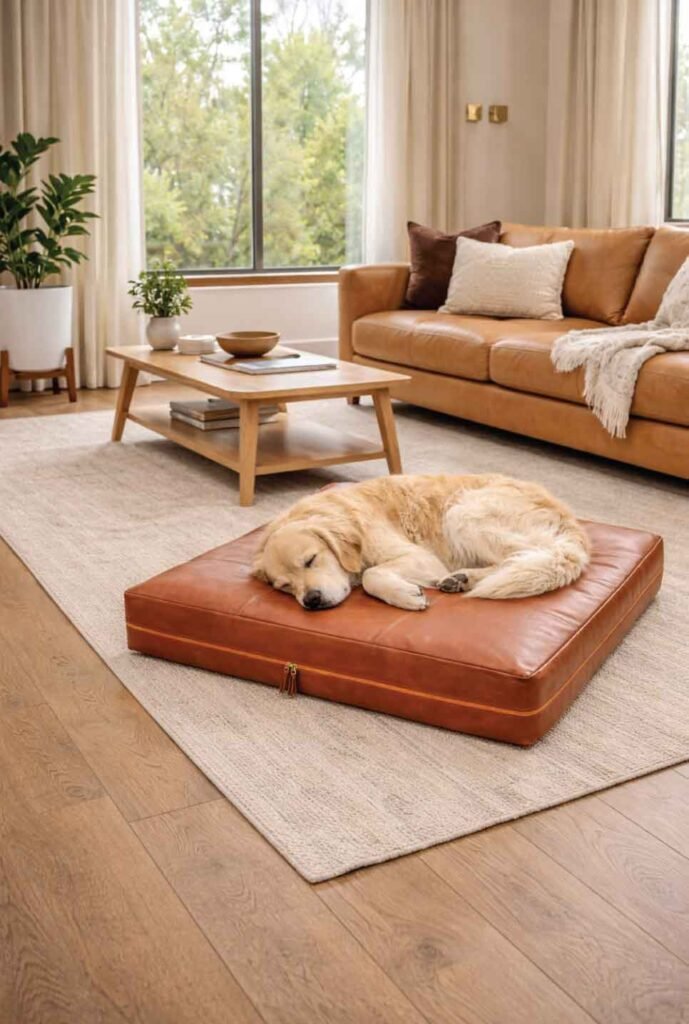
Know your dog’s coat color and plan around it. If you have a Golden Retriever who sheds honey-blonde fur year-round, warm neutrals in the tan, cream, and caramel family will camouflage stray hairs far better than stark white or charcoal grey. If you have a black Lab, darker tones and deep browns work in your favor.
But here’s the counterintuitive part: you don’t have to match exactly, you just need to work within the same color temperature. A light-colored dog and light-colored furniture in the warm neutral family create visual cohesion even when there’s some shedding. The goal isn’t invisibility; it’s avoiding harsh contrast.
Warm Neutrals: The Most Forgiving Palette
There’s a reason that high-end hotels and restaurants favor warm neutral palettes, they’re sophisticated, they age well, and they’re incredibly forgiving of daily wear. For dog owners, this palette is pure magic.
The warm neutral family includes:
- Cream and ivory tones
- Tan, camel, and sand
- Warm grey (greige)
- Deep chocolate and cognac browns
- Terracotta and rust accents
These colors hide a multitude of sins: light pet hair, muddy paw prints (once dried), and general wear patterns that would be glaringly obvious on stark white or true grey surfaces.
The Power of Texture and Layering
Here’s where you can introduce visual interest without sacrificing practicality: texture creates depth and dimension in a monochromatic palette while also serving a functional purpose.
Layer your sofa with washable linen throws in complementary tones, they protect your upholstery, add coziness, and can be tossed in the wash weekly. Use pillows in varied textures (nubby bouclé, smooth leather, chunky knits) to create visual interest. The varied textures disguise light pet hair far better than smooth, solid surfaces.
A chunky knit throw in cream over a camel leather sofa with your dog’s cognac leather bed nearby? That’s a cohesive design story that happens to be incredibly pet-friendly.
Layout & Flow: Organizing for Two Species
Now that we’ve covered materials and colors, let’s talk about spatial planning, because where you place things matters just as much as what you choose.
Understanding the “Traffic Pattern”
Your dog has a preferred traffic pattern through your home, even if you’ve never consciously noticed it. They have spots they naturally gravitate toward, usually areas where they can see multiple entry points, stay near their humans, and still feel somewhat protected. Fighting against these natural preferences is a losing battle.
Instead, work with them:
Place your dog’s bed in a low-traffic but high-visibility area. This sounds contradictory, but it’s not. Your dog wants to be part of the action without being stepped over constantly. The perfect spot is often:
- Next to the sofa (not in front of it where people walk)
- In front of a window with a view of the yard
- Near the fireplace or a heat source
- Alongside a wall where they have a “back” for security
The key is that your dog should feel included in family life, not exiled. A dog bed shoved in a back hallway might keep your living room looking pristine for guests, but your dog will abandon it in favor of your sofa the moment you sit down. Better to give them a designated, comfortable spot in the social area from the beginning. Dogs that feel included and relaxed at home are often calmer and more responsive when guests arrive.
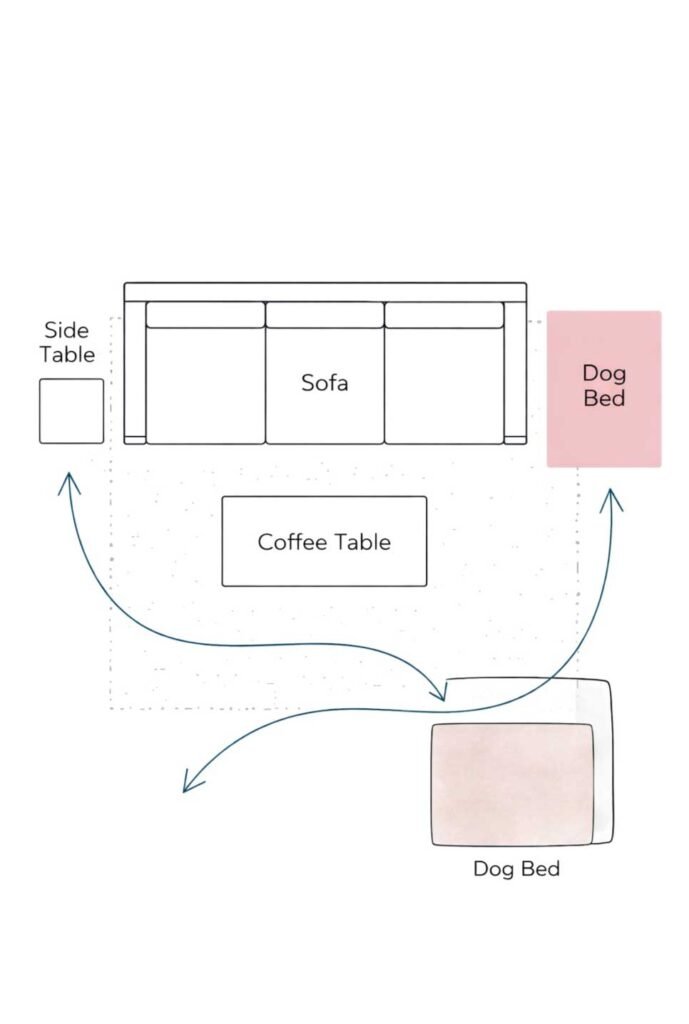
The Multi-Functional Corner Strategy
Here’s a design trick that interior designers use constantly: create zones within your living room using furniture groupings.
A side table or console table with open space underneath is perfect for a structured dog bed. The table defines the “zone” as intentional rather than accidental, and if your dog’s bed is beautiful enough (like the Le Bed), it reads as part of the furniture arrangement.
This also works with:
- A low bookshelf creating a backdrop for the dog’s corner
- An accent chair paired with a dog bed to create a “reading nook” area
- A floor lamp positioned to define the space
The goal is to make the dog’s area look like it was planned as part of the room design, because it was.
Decluttering the Toy Box
One of the biggest design mistakes dog owners make is storing dog toys in brightly colored plastic bins that scream “KIDS’ PLAYROOM” rather than sophisticated living space.
- The upgrade is simple: invest in natural fiber storage that looks like décor. Seagrass baskets, leather bins, or woven jute containers can hold toys, spare leashes, and grooming supplies while looking intentionally chosen. Place them on a low shelf or underneath a console table for easy access that doesn’t disrupt the visual flow.
- Pro tip: Rotate toys weekly and keep only a few out at a time. This keeps your space tidier and makes each toy more exciting for your dog when it reappears.
Managing the “Extras”: Walks, Treats, and Gear
Your dog’s bed might be the largest single element, but it’s all the small accessories, leashes, collars, poop bags, treats, that create visual clutter and break the design spell you’ve worked so hard to create.
The Stylish Entryway Solution
Your entryway should function like a mudroom even if you don’t have an actual mudroom. This is where you’ll wrangle your dog before and after walks, so it needs to be both functional and attractive.
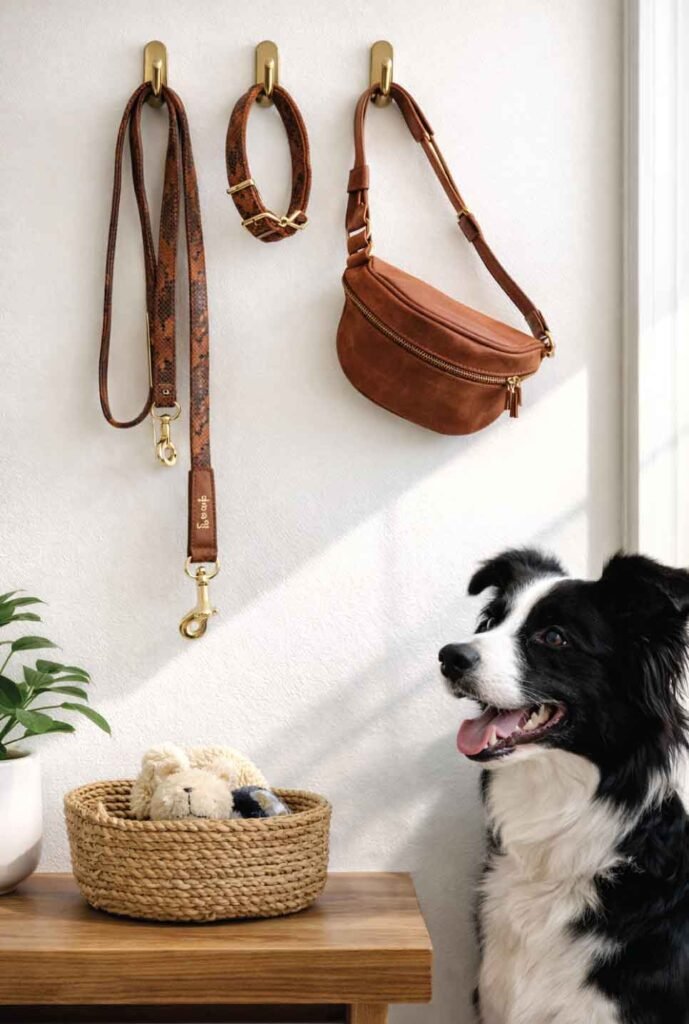
Install hooks (brass or matte black hardware depending on your aesthetic) at dog-leash height. But here’s the crucial part: what you hang on those hooks matters. A neon nylon leash with a plastic clip ruins the effect even if the hooks are beautiful.
The Le Walk Collection: When Function Looks Like Fashion
This is where Le Dog Company’s walking accessories become genuinely transformative for your space.
The Padded Leather Leash and Collar aren’t trying to look like pet gear, they look like leather goods you’d find in a boutique. The same Italian leather, the same quality hardware, the same attention to detail that makes their beds special. When these items are hanging by your front door, they read as intentional design choices rather than necessary pet equipment.
The genius of the Le Fanny Pack is that it solves the “dog walk to coffee shop” lifestyle challenge that so many dog owners face. You need to carry poop bags, treats, keys, phone, and wallet. The traditional solution? Stuff everything in your pockets or carry a separate “dog bag” that looks decidedly un-chic. The Le Fanny Pack is designed to look like a fashion accessory first, the kind you’d wear even without a dog, but it’s engineered specifically for dog walking with dedicated pockets for all your essentials.
The result? You can go from morning dog walk to coffee date to running errands without looking like you’re wearing dog-walking gear. It’s available in sophisticated colors (Black, Cognac Tan, Bone, Grass Green) that coordinate with any outfit and, importantly, with the other leather pieces in your home.
When this fanny pack is hanging by your door next to your leather leash, it looks curated, like part of a thoughtful entryway design, rather than haphazardly accumulated pet supplies.

Scent Management: The Unspoken Element
Let’s talk about something people whisper about but rarely address directly: the “dog smell” that can permeate a home regardless of how clean you keep it.
The solution isn’t to mask it with heavily scented candles that give everyone a headache. Instead:
- Invest in pet-safe diffusers with subtle, natural scents. Eucalyptus, lavender, and citrus are naturally deodorizing and safe for dogs when properly diluted. Run them for an hour before guests arrive rather than constantly.
- Proper ventilation makes the biggest difference. Open windows regularly, even for just 15 minutes on cold days. Stagnant air holds odors; fresh air circulation is your best defense.
- Address the source rather than covering it up. This circles back to our earlier discussion about leather surfaces, they don’t trap odors the way fabric does. When your dog’s bed, walking gear, and even their feeding area use wipeable surfaces, you eliminate the primary sources of lingering smells.
Maintenance: The 10-Minute Designer Reset
Even the most beautifully designed pet-friendly living room needs regular maintenance to stay Pinterest-ready. The good news? If you’ve made the right material and furniture choices, maintenance is remarkably simple.
Your Daily Checklist (10 minutes or less):
- Wipe down leather surfaces with a damp cloth, the dog bed, the sofa if it’s leather, any leather accessories. This takes 2 minutes and prevents the buildup of oils and dirt.
- Quick vacuum of high-traffic areas. You don’t need to vacuum the entire room daily, just the paths where your dog walks most frequently. A cordless stick vacuum makes this effortless.
- Fluff and straighten the “pet station.” Adjust the dog bed if it’s been pushed around, straighten any throws or blankets, return toys to their basket. This takes 1 minute and makes the space look intentional rather than chaotic.
- Spot-check for accidents or messes. A quick visual scan saves you from discovering surprises later.
- Open a window for 5 minutes. Fresh air circulation, you’re done.
Weekly Deep Clean (30 minutes):
- Wash any fabric throws or pillow covers
- Vacuum thoroughly, including under furniture
- Wipe down baseboards (dog height = prime dirt zone)
- Condition leather furniture and accessories with appropriate leather balm
- Clean food and water bowls
The beautiful part? When you’re working with quality materials that are designed for easy maintenance, cleaning never feels overwhelming. You’re not battling against your choices; you’re maintaining them.
Conclusion: Your Home, Your Sanctuary, Your Dog’s Joy
Creating a stylish, pet-friendly living room isn’t about compromise, it’s about making intentional choices that serve both your aesthetic vision and your dog’s well-being.
The traditional narrative says you have to choose: either you have a beautiful home, or you have dogs. That’s a false choice created by an industry that has conditioned us to accept low-quality pet products that clash with good design.
The truth is simpler and more elegant: invest in pieces that are beautiful enough to display prominently and functional enough to withstand daily life with dogs. Choose materials that work with your lifestyle rather than against it. Design spaces that welcome your dog into the heart of your home rather than pushing them to the margins.
When you walk into your living room and see your dog comfortably resting on their orthopedic leather bed that complements your sofa, when your leather leash hangs by the door like a design accent rather than hidden in a closet, when your entire space feels cohesive and intentional, that’s when you’ll realize that “pet-friendly” and “beautiful” were never opposites at all.
A stylish home is a form of self-care. It’s a daily gift you give yourself every time you walk through the door. And when that home is designed to welcome your beloved dog with the same thoughtfulness you extend to every other element, the joy multiplies.
Ready to transform your living room into a space that serves both your design standards and your dog’s comfort? Explore the Le Dog Company collection and discover what’s possible when pet products are designed with the same care and attention as fine furniture. Your dog, and your living room, will thank you.
The key is balancing your dog's comfort needs with your available space. Measure your dog from nose to tail while they're sleeping in their natural stretched-out position, then add 6-8 inches. This ensures they have adequate room to move without feeling cramped. For living room placement, consider the visual weight of the bed in relation to your other furniture, a large dog bed next to a delicate side table will look disproportionate, but paired with a substantial sofa, it creates balance. Le Dog Company's Le Bed comes in multiple sizes specifically designed to integrate into various room layouts, with dimensions that work whether you're placing it in a cozy apartment or a spacious open-concept living area. If you're working with limited square footage, look for beds with a structured, geometric footprint rather than sprawling fabric designs, they'll take up less visual space even if the actual dimensions are similar.
Yes, high-quality leather is actually one of the best options for dogs with allergies or skin sensitivities. Unlike fabric beds that trap dust mites, pollen, dander, and other allergens deep within their fibers, leather provides a non-porous surface that doesn't harbor these irritants. This is particularly important for dogs with atopic dermatitis or environmental allergies. The wipeable nature of leather means you can easily remove allergens with a damp cloth rather than relying on washing cycles that never fully eliminate microscopic particles. Additionally, properly treated leather (like the Italian leather used in premium dog beds) is naturally antimicrobial and resistant to mold and mildew growth, common triggers for allergic reactions. If your dog has contact allergies, ensure the leather is vegetable-tanned or chrome-free, as some tanning processes can cause sensitivities in very rare cases. The orthopedic foam core should also be CertiPUR-US certified to ensure it's free from harmful chemicals and off-gassing that could irritate sensitive dogs.
This is where the investment in quality leather truly pays off, a well-maintained leather dog bed can last 10+ years, while fabric beds typically need replacement every 1-2 years. The math is compelling: if you're spending $50-80 on a fabric dog bed every year or two, you'll spend $500-800 over a decade. A premium leather bed might cost $300-400 upfront but lasts the entire period, saving you money in the long run while also reducing waste. Leather accessories like collars and leashes have similar longevity, a quality leather leash can easily last your dog's entire lifetime with proper care, while nylon leashes fray, fade, and need replacement every couple of years. The key to maximizing lifespan is regular maintenance: wipe down leather surfaces weekly, condition them monthly with appropriate leather balm, and keep them away from prolonged direct sunlight which can cause fading. Unlike fabric that deteriorates and looks progressively worse over time, leather develops a beautiful patina that actually enhances its appearance with age, meaning your investment looks better year after year rather than showing visible wear.
The beauty of leather is that cleaning muddy paws is remarkably simple, wait for the mud to dry completely, then brush off the dried dirt and wipe with a damp cloth. This might seem counterintuitive (shouldn't you clean it immediately?), but wet mud smears and can push deeper into leather grain, while dried mud brushes away cleanly. For the actual cleaning, use a microfiber cloth dampened with plain water or a 50/50 mixture of water and white vinegar for tougher stains. Avoid harsh chemical cleaners, saddle soap, or household cleaning products that can strip leather's natural oils and cause cracking over time. For daily maintenance, a simple wipe-down with a damp cloth removes surface oils from your dog's paws and fur. Monthly conditioning with a quality leather balm (like Le Dog Company's Leather Balm & Cleaner) keeps the leather supple and prevents drying or cracking. If your dog regularly comes in with muddy paws, consider the preventive approach: keep a towel by the door and wipe paws before they reach the leather surfaces, or invest in a washable outdoor mat in your entryway. The wipeable nature of leather means that even if accidents happen, you're never facing the same level of stress as trying to remove set-in stains from fabric upholstery.
Absolutely, leather is actually a cornerstone material in both minimalist and Scandinavian design philosophies. The key is choosing the right leather tones and silhouettes that align with these aesthetics. For Scandinavian spaces that emphasize light, natural materials, and functionality, opt for lighter leather shades like Bone, natural tan, or light grey that complement the blonde woods and white walls typical of this style. The clean, structured lines of a quality leather dog bed mirror the simplicity and functionality that Scandinavian design prizes, no unnecessary embellishments, just honest materials and thoughtful construction. For minimalist interiors that focus on "less but better," leather perfectly embodies this principle: it's a single, high-quality material that eliminates the need for multiple cheaper alternatives. Instead of a fabric bed with a removable cover, waterproof liner, and constant replacement cycle, you have one elegant piece that serves all functions. The neutral color palette of premium leather (blacks, browns, creams, greys) integrates seamlessly into minimalist spaces without adding visual noise. Consider monochromatic coordination, if your minimalist living room features black metal accents and white walls, a black leather dog bed disappears into the design language rather than disrupting it. The "less is more" philosophy applies to pet accessories too: one beautiful leather leash hanging by the door reads as intentional design, while a collection of colorful nylon leashes creates clutter.
Most dogs adapt to a new leather bed within 24-48 hours, but you can make the transition smoother with a few strategic steps. Start by placing the new leather bed next to their old bed rather than immediately removing the familiar option, this allows them to investigate and choose on their own terms. Dogs are naturally drawn to high-quality orthopedic support because it feels better on their joints, so many will voluntarily migrate to the new bed once they experience the comfort difference. You can encourage this by placing their favorite blanket or a worn t-shirt with your scent on the new bed to make it smell familiar. Reward them with treats when they investigate or rest on the new bed, creating positive associations. Some dogs (particularly older dogs set in their routines) might be initially hesitant about the leather texture or the different feel of structured foam versus their saggy old bed. For these dogs, spend time sitting near the new bed, petting them while they're on it, or even joining them on the floor nearby during your evening routine. Within a few days, the new bed becomes "theirs" through scent marking and habit formation. If your dog absolutely refuses the new bed after a week, check the size, it might be too small for them to comfortably stretch out, or positioned in a location they find less secure than their old spot. The orthopedic benefits of proper support are significant enough that most veterinarians recommend the transition even for dogs who initially resist change, particularly for senior dogs or breeds prone to joint issues.